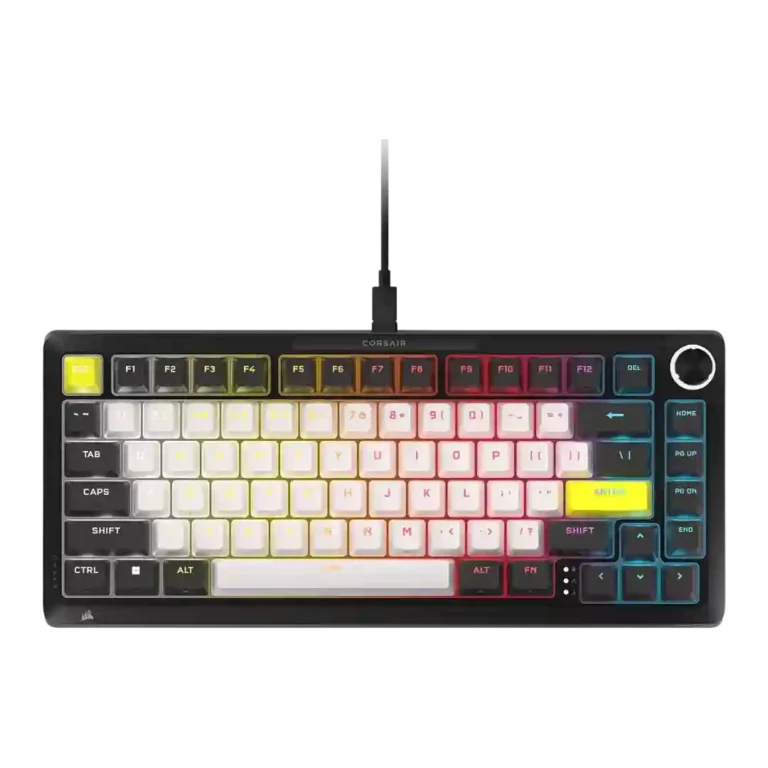
- Compared: form factor and switch technology ASUS ROG Falchion Ace 75 HE is named as a direct competitor in the same form factor.
Corsair Makr Pro 75 Review
Bottom Line
Choose the Corsair Makr Pro 75 if you want a heavy aluminum Hall Effect board with polished customization and fast gaming response. Skip it if price, wireless out of the box, softer typing, or thocky acoustics matter most.
Best for Corsair users, competitive players, and keyboard tinkerers who want a heavy aluminum 75% Hall Effect board with rapid trigger, deep actuation tuning, and a strong rotary control.
Not for buyers who want wireless included, a light portable keyboard, low pricing, open-ended switch compatibility, or a softer, deeper custom-keyboard typing sound.
The Corsair Makr Pro 75 earns broad praise as a premium 75% Hall Effect keyboard with a dense aluminum build, strong gaming responsiveness, deep actuation control, and a useful rotary knob. Reviewers often liked the smooth switches, compact layout, and Web Hub customization, and several considered the board unusually solid for a mainstream gaming keyboard. The tradeoff is that its enthusiast positioning does not fully escape gaming-keyboard compromises: typing feel can be stiff, stabilizer and acoustic impressions vary widely, wireless costs extra in several reviews, and value looks weaker beside cheaper Hall Effect competitors. It is best understood as a polished, heavy, Corsair-centered performance board rather than a universally satisfying custom-keyboard substitute.
Compared in Reviews
Products reviewers directly compared with this model, grouped into quick takeaways.
- Better: typing productivity Kyusai reports lower typing speed on the Makr Pro 75 than on boards like the Be quiet! Light Mount.
- Worse: customization Basic Tutorials says the MAKR Pro 75 offers deeper customization than the Glorious GMMK 3 Pro.
Feature Scorecards
Summary
49 reviewed features- Very positive 4.5-5.0 51% 25 features
- Positive 3.5-4.4 31% 15 features
- Neutral 2.5-3.4 14% 7 features
- Negative 1.5-2.4 4% 2 features
- Very negative below 1.5 0% 0 features
Pros
-
Durability evidence was positive, citing sturdy construction, long-lasting legends, and contactless switch design.
-
Per-key lighting control was viewed positively through detailed individual-key customization and programmable lighting.
-
The aluminum frame was repeatedly described as rigid, stable, and resistant to creaks or flex.
-
The 75% layout itself was praised as well balanced, spacious for its footprint, and close to ideal for several reviewers.
-
Latency evidence was strongly positive, especially around immediate feel, low-latency operation, and wired-equivalent responsiveness.
-
The rotary volume control was consistently praised as useful, tactile, clever, and easy to use.
-
Reviewers overwhelmingly agreed the board feels premium, solid, and well built, with only value and DIY-positioning caveats tempering the praise.
-
Rapid Trigger was repeatedly praised as useful, well implemented, or genuinely valuable for competitive movement.
-
Responsiveness was one of the clearest strengths, with many reviewers describing immediate, precise, or faster inputs.
-
Material quality was widely praised, especially the aluminum construction and premium physical feel.
-
Switch replacement was generally judged easy, especially when reviewers described quick hot-swap access and simple replacement.
-
RGB customization was praised for detailed control, per-key programmability, and broad aesthetic tuning.
-
The 75% footprint was repeatedly praised for freeing mouse space while keeping important keys accessible.
-
RGB lighting quality was generally positive for tasteful, vivid, or flexible lighting, though a few reviewers found the implementation unremarkable or uneven.
-
Media-control evidence was positive where reviewers praised the knob's broad functions and creative-control usefulness.
-
Legend visibility scored well, with reviewers praising readability, shine-through clarity, and double-shot durability.
-
The compact layout was still considered usable, with enough arrow-key spacing and little sense of cramping.
-
Brightness was judged strong enough for daylight visibility with readable legends.
-
Gaming performance was usually praised as excellent or highly responsive, though one reviewer found the overall experience solid but unspectacular.
-
8,000Hz polling was usually treated as fast and performance-oriented, though one reviewer said it made no practical difference in use.
-
The 75% form factor was broadly praised as compact but practical, though the heavy chassis limited travel convenience.
-
One review praised retained settings through onboard profiles, giving the keyboard useful standalone configuration behavior.
-
Profile management earned positive evidence from the keyboard retaining saved onboard profiles when disconnected.
-
Switch feel was generally praised for smooth, pre-lubed linear travel, although one reviewer found the switches only fine and loud.
-
Most reviewers liked the clean, premium, bold look, though the white, black, and yellow color scheme was not universally loved.
-
Customization was one of the strongest themes, with praise for upgrade modules, actuation tuning, lighting control, and broad software control, though modularity confused some reviewers.
-
Key stability was generally positive, with smooth, stable switches, non-wobbly keys, and useful gaming firmness.
-
Hot-swap evidence was positive where reviewers judged replacement easy, though one noted the capability is limited to compatible magnetic switches.
-
Reliability was mostly positive after use, with praise for accurate inputs and no missed presses, but one reviewer had poor out-of-box ghost-key behavior.
-
Typing comfort was mixed: several reviewers found it comfortable for long sessions, while others found the stiff feel tiring or productivity-hampering.
-
One review treated analog input as niche but genuinely useful for users who need proportional key-depth control.
-
Sound dampening was often praised for reducing hollow resonance and improving feel, but some reviewers felt the board was over-dampened or still compromised by stabilizers.
-
Software opinions were split: several reviewers praised Web Hub as polished, easy, or powerful, while others found iCUE/Web Hub frustrating, dense, sluggish, or limited.
-
Keycap impressions were mixed: several reviewers praised texture, durability, and premium feel, while others found them slick, hollow, or ordinary.
-
Hall Effect gaming extras such as Rapid Trigger, FlashTap, and SOCD were praised, but several reviewers complained about the missing easy Game Mode control.
-
Typing feel was polarized, ranging from joyful, smooth, and precise to stiff, disappointing, or overly rigid.
-
Battery-life evidence was split: one review criticized the optional wireless module's reduced endurance, while another praised weeks between charges.
-
Actuation drew praise when calibrated or dialed in, but one reviewer reported out-of-box travel and calibration inconsistency.
-
Most reviewers found the sound better than typical gaming keyboards, controlled, or even excellent, but several noted it lacked depth, sounded average, or felt over-dampened.
-
Cable impressions were mixed: the included cable felt durable and flexible, but one reviewer disliked needing USB-A-to-USB-C accessories.
Cons
-
Stabilizer evidence was sharply mixed, ranging from praised stable larger keys to strong complaints about rattle, thin lubing, and poor tuning.
-
Connectivity was a recurring tradeoff: optional wireless expanded flexibility, but many reviewers disliked paying extra or lacking wireless by default.
-
Ergonomic evidence was mixed, with some appreciation for adjustable feet but recurring criticism of stiffness, height, or wrist-angle strain.
-
Value was the most frequent concern: reviewers respected the build and feature set, but many said cheaper Hall Effect competitors were easier to justify.
-
Wireless evidence was mixed: some reviews praised or described strong wireless behavior, but most criticized wireless as optional, costly, or absent by default.
-
Compatibility evidence leaned mixed, with concerns about Mac-first use and USB-A cabling despite broader platform support.
-
Switch-option evidence was limited and negative because standard MX tactile and clicky switches are not usable on the Hall Effect PCB.
-
Noise-level evidence was mixed-to-negative: some appreciated the controlled sound, but others found it loud or less pleasant than competitors.
-
Portability was consistently weak because reviewers repeatedly emphasized the heavy near-1.3 kg body.
Compared With Category Average
Compared with other Gaming Keyboards, this product is above average in rapid trigger support, volume control, legend visibility, below average in noise level, portability, wireless performance.
Summary
8 compared features- Above average 0.4+ pts higher 50% 4 features
- Same as average within 0.3 pts 0% 0 features
- Below average 0.4+ pts lower 50% 4 features
| Attribute | This product | Category average | Difference |
|---|---|---|---|
| noise level | 2.4 | 3.8 | -1.4 |
| portability | 2.1 | 3.4 | -1.3 |
| rapid trigger support | 4.8 | 3.7 | +1.1 |
| wireless performance | 2.9 | 4.0 | -1.1 |
| volume control | 4.9 | 3.7 | +1.1 |
| compatibility | 2.7 | 3.8 | -1.2 |
| legend visibility | 4.6 | 3.5 | +1.1 |
| ease of switch replacement | 4.7 | 3.7 | +1.0 |
FAQ
Is the Corsair Makr Pro 75 good for competitive gaming?
Yes. Reviewers repeatedly praised the rapid trigger support, 8,000Hz polling, FlashTap/SOCD features, and responsive Hall Effect switches, though one reviewer felt the gains were marginal for lower-level players.
How does it feel for typing?
Typing impressions are mixed. Some reviewers found it comfortable, precise, and enjoyable for long writing sessions, while others found the stiff feel tiring or less satisfying than boutique boards.
Does it sound like a premium custom keyboard?
Not consistently. Several reviewers liked the controlled or improved sound, but others said it was too stiff, muted, scratchy, loud, or not as deep and pleasant as competitors.
Is wireless included?
Reviewer evidence repeatedly treats wireless as optional or extra rather than included by default. Several reviews criticized that choice because it raises the total cost.
Is the software good?
Software is one of the most divided areas. Some reviewers called Corsair Web Hub polished, clean, and powerful, while others found iCUE/Web Hub frustrating, dense, sluggish, or limited.
Is it worth the price?
Only for buyers who value the aluminum build, Corsair ecosystem, gaming features, and customization. Many reviewers still argued that competing Hall Effect keyboards offer better value.
Sample Expert Reviews We Analyzed
These are a few of the reviews included in our analysis.

Video Reviews
- Review score
- 4.6/5
- Review score
- 3.1/5
Article Reviews
- Review score
- 4.2/5
- Review score
- 4.2/5
- Review score
- 4.7/5
Consider This Instead
If you want better portability
Choose Alienware Pro Wireless Gaming Keyboard. It scores 4.7 vs 2.1 for portability, with a 4.3 overall score.
If you want better noise level
Choose ASUS ROG Falchion RX. It scores 4.9 vs 2.4 for noise level, with a 4.2 overall score.
If you want better value for money
Choose McHose GX87 Keyboard. It scores 4.9 vs 3.1 for value for money, with a 4.2 overall score.
If you want better wireless performance
Choose Keychron K10 HE. It scores 5.0 vs 2.9 for wireless performance, with a 4.2 overall score.
Overall Top Gaming Keyboards Alternatives
Good if you want a premium 96% Hall Effect keyboard for work and gaming with excellent build, sound, and customization. Skip it if you need cheaper esports-first speed, 8,000Hz polling,...
Pros: cable quality, typing comfort
Cons: portability, switch options
Good if you want a premium full-size Hall Effect keyboard with smooth switches, quiet sound, and deep customization. Skip it if you need a portable, budget-friendly board or broad switch...
Pros: key stability, frame rigidity
Cons: portability, switch options
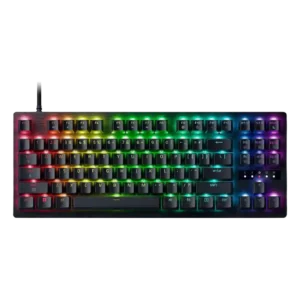
Good if you want a compact Hall Effect keyboard with smooth typing, strong gaming response, bright RGB, and good value. Skip it if you need polished software, quiet heavy presses,...
Pros: desk space efficiency, layout options
Cons: compatibility
Good if you want a premium, quiet TKL Hall Effect keyboard for typing and gaming. Skip it if price, portability, 8,000Hz polling, or broad switch choice matters most.
Pros: build quality, extra gaming features
Cons: switch options, hot-swappable switches