- Worse: running and fitness tracking The reviewer frames the Garmin as a better option than Apple Watch for runners and fitness enthusiasts.
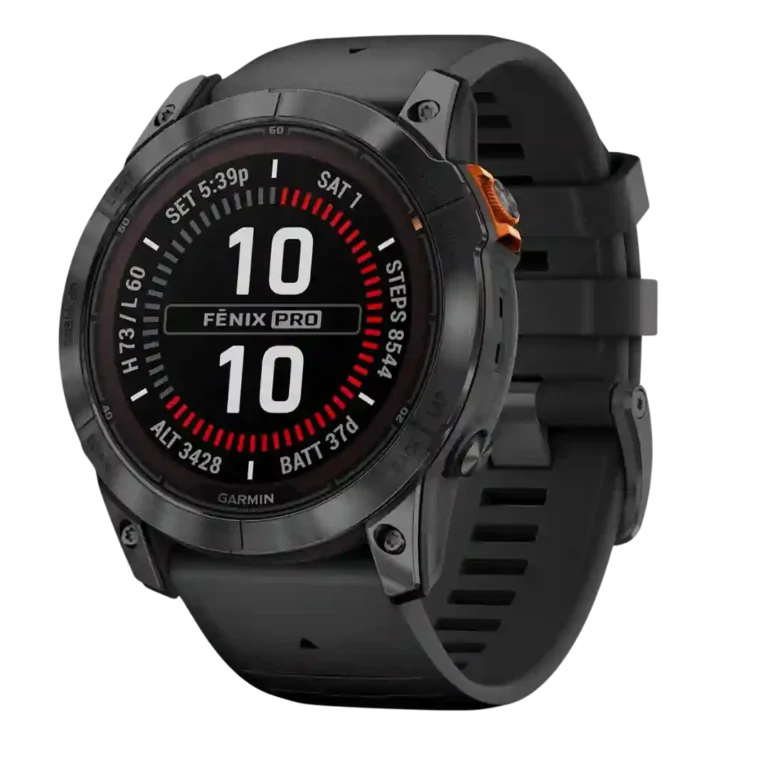
Garmin fēnix 7X Pro Review
Bottom Line
Choose the Garmin fēnix 7X Pro if you want rugged outdoor GPS, long battery life, deep training metrics, and maps. Skip it if you want Apple-level apps, LTE, faster charging, or a cheaper, lighter watch.
Best for outdoor athletes, trail runners, hikers, and endurance users who want long battery life, strong GPS, maps, rugged materials, and deep training or recovery data in one watch.
Not for users who mainly want a lightweight smartwatch, Apple-style app polish, LTE-style independence, fast charging, or a lower-cost device for basic runs and notifications.
The Garmin fēnix 7X Pro comes across as a serious outdoor and endurance watch first, with smartwatch extras second. Reviewers repeatedly praised its GPS accuracy, rugged construction, long battery life, broad activity profiles, maps, button controls, and training or recovery metrics. The main tradeoff is that the same depth makes it expensive, bulky for some wrists, and less polished as a smartwatch than Apple-style wearables. Evidence was also mixed on the Garmin Connect experience, payment support, music handling, auto backlight behavior, charging speed, and some newer scores such as Hill Score or Endurance Score. Overall, the review evidence favors it for users who will wear it daily and use its outdoor, training, navigation, and battery strengths heavily.
Compared in Reviews
Products reviewers directly compared with this model, grouped into quick takeaways.
- Similar: multiband GPS accuracy Apple Watch Ultra is one of the few watches described as reaching similar GPS-track quality.
- More expensive: display and price positioning The reviewer says the Forerunner 965 weakens the Fenix 7 Pro's appeal because it costs less and has a better display.
Feature Scorecards
Pros
-
Customization was a major strength, especially data screens, watch functions, and analytics layouts.
-
Workout variety was a major strength, with reviewers citing broad sport profiles and near-any-activity coverage.
-
Durability was excellent, with scratch resistance, military-standard toughness, and minimal scratching reported.
-
GPS accuracy was one of the clearest strengths, with reviewers repeatedly reporting fast locks, reliable tracks, and strong navigation accuracy.
-
Build quality was praised as rugged, premium, and durable enough for outdoor abuse.
-
Reliability was strong in race and GPS-use evidence, with no dropouts reported in demanding conditions.
-
Battery life was a standout strength across reviews, although real-world heavy use could reduce it substantially.
-
Heart-rate accuracy was repeatedly praised, especially versus prior Garmin sensors, with the usual caveats around wrist optical sensors in harder conditions.
-
Button controls were a clear strength, especially for wet, gloved, or active use.
-
Recovery and readiness tools were described as central strengths, especially Training Readiness and recovery-time related metrics.
-
Water resistance was strong, with 10 ATM and 100-meter waterproof evidence.
-
Band quality was positive in the dedicated strap evidence, especially the soft silicone strap.
-
Outdoor visibility was strong thanks to large, legible data fields and readable presentation during activities.
-
Pairing and syncing reliability were strong in the test evidence, including crowded watch-testing conditions.
-
Size options were strong, with 42mm, 47mm, and 51mm models and a commonly praised 47mm sweet spot.
-
Materials quality was strong, with titanium, steel, sapphire, polymer, and premium construction repeatedly mentioned.
-
Safety features were a strength, spanning flashlight, LiveTrack/location sharing, incident assistance, and inReach-style peace of mind.
-
Coaching features were useful for adapting training guidance, including recommendations and acclimation-style insights.
-
Style and design were liked by reviewers who described it as wearable, handsome, and adventure-oriented.
-
Touchscreen responsiveness was generally strong, including wet-use praise, though one owner preferred disabling touch in the field.
-
Wellness insights were extensive, combining sleep, stress, energy, HRV, and PulseOx style metrics.
-
Bluetooth connectivity was described as sufficient for the reviewer's GPS-watch use case.
-
Stress tracking appeared through HRV-based insights that help connect recovery, strain, and readiness.
-
Watch face quality was strong for customization, with Garmin and third-party face flexibility noted.
-
Reviewers found the health metrics broadly useful and consistent, though they framed them as training-oriented insight rather than medical-grade measurement.
-
Onboard music storage was strong on capacity, but the syncing workflow could feel dated.
-
Fitness tracking accuracy was strong in controlled GPS and heart-rate testing, though one owner found some training estimates limited.
-
Display quality improved over older Fenix models, but reviewers still compared it unfavorably with AMOLED alternatives.
-
Blood oxygen and PulseOx were described as part of the broader sensor set and useful for environmental or wellness context.
-
Wi-Fi support was present for smartwatch features, apps, and map workflows.
-
Comfort was mostly positive, though the strap and large case could be less comfortable for some users.
-
Smartwatch features were useful but secondary, covering notifications, music, payments, and basic tools rather than full smartwatch depth.
-
Brightness evidence was mixed: some praised the brighter display and flashlight, while auto backlight and AMOLED comparisons drew criticism.
-
Sleep tracking was generally useful and sometimes very satisfying, but one reviewer saw false nap logging, so accuracy is good rather than flawless.
-
Companion app quality was mixed: Garmin Connect had strong data and integration, but some reviewers found it dated or dense.
-
The user interface was polarizing, praised as natural by testers but criticized by an owner as buried and unintuitive.
-
Phone notifications worked, but the evidence framed them as basic wrist alerts rather than a rich phone replacement.
-
Call handling was limited to seeing whether a call or text required attention rather than full smartwatch-style calling.
-
Menu navigation was split: the watch navigation felt easy to some, while Garmin desktop/app workflows frustrated another reviewer.
Cons
-
The app ecosystem was mixed, with Garmin apps, Strava, Spotify, and Connect IQ present but less smooth than Apple-style ecosystems.
-
Contactless payment support existed through Garmin Pay, but bank support and regional usefulness were inconsistent.
-
Charging convenience was mixed: solar helped extend life, but large map downloads still needed a charger.
-
Music controls were adequate in some reviews, though Spotify and playlist handling were criticized elsewhere.
-
Fit was a caveat for smaller wrists because the 7X Pro can feel heavy and bulky.
-
Value for money was mixed: some saw the high price as justified by daily use, while others favored cheaper alternatives or discounted older models.
-
Cross-platform behavior was mixed, with Android offering replies while iPhone users were limited by platform restrictions.
-
Software smoothness had caveats, including slower post-workout chart loading and some widget/menu bugs.
-
Automatic behavior was mixed: automatic lap markers helped structured workouts, but one reviewer disliked the lack of workout-stop reminders.
-
The operating-system experience was less polished than Apple or Wear OS style watches.
-
Third-party app support was a weakness, with reviewers noting limited big-name apps and a thinner app/widget experience.
-
Charging speed was a weakness in the evidence, with one reviewer saying the newer Fenix 7 Pro still took nearly two hours.
-
LTE or standalone connectivity was not a strength; one review explicitly pointed phone-free connectivity shoppers toward a full smartwatch.
-
ECG evidence was mixed by timing: some review content described ECG capability, while others said it was not enabled or certified at launch.
-
Calorie tracking usefulness was weak in the owner review evidence, especially for weightlifting and resistance training.
Compared With Category Average
Compared with other Smart Watch, this product is above average in size options, onboard music storage, GPS accuracy, below average in charging speed, calorie tracking usefulness, operating system experience.
| Attribute | This product | Category average | Difference |
|---|---|---|---|
| charging speed | 2.5 | 4.1 | -1.6 |
| calorie tracking usefulness | 2.0 | 3.5 | -1.5 |
| size options | 4.5 | 3.1 | +1.3 |
| onboard music storage | 4.1 | 2.8 | +1.3 |
| operating system experience | 2.8 | 3.8 | -1.0 |
| GPS accuracy | 4.7 | 4.0 | +0.7 |
| reliability | 4.7 | 3.7 | +1.0 |
| activity auto-detection | 2.9 | 3.8 | -0.9 |
FAQ
Is the Garmin fēnix 7X Pro good for outdoor navigation?
Yes. Reviewers repeatedly praised its GPS accuracy, fast satellite lock, onboard mapping, and route/navigation tools, especially for trails, hiking, and endurance use.
How good is the battery life?
Battery life is one of the strongest points in the reviews. Several reviewers reported multi-day or multi-week use, though heavy GPS, music, and tracking can reduce real-world runtime.
Is it a full smartwatch replacement?
Not for everyone. It handles notifications, music, Garmin Pay, apps, and basic smart features, but reviewers found it less polished than Apple Watch-style smartwatch ecosystems.
Is the watch comfortable enough for daily wear?
Most reviewers found it wearable and comfortable, especially with the 47mm size or softer straps. The 7X Pro can feel bulky or heavy on smaller wrists.
How accurate are the GPS and heart-rate sensors?
GPS accuracy received very strong praise across reviews. Heart-rate accuracy was also improved and generally strong, though reviewers still noted the normal limits of wrist optical sensors.
Is the Garmin fēnix 7X Pro worth the price?
It is easier to justify for users who wear it daily and rely on maps, training metrics, ruggedness, and battery life. Several reviewers cautioned that cheaper or older Garmin models may be better values for simpler needs.
Consider This Instead
If you want better calorie tracking usefulness
Choose Amazfit T-Rex 3 Pro. It scores 5.0 vs 2.0 for calorie tracking usefulness, with a 3.7 overall score.
If you want better ECG functionality
Choose Apple Watch Series 11. It scores 4.5 vs 2.1 for ECG functionality, with a 4.2 overall score.
If you want better charging speed
Choose Garmin Forerunner 955. It scores 4.8 vs 2.5 for charging speed, with a 4.0 overall score.
If you want better third-party app support
Choose Samsung Galaxy Watch 8. It scores 4.8 vs 2.7 for third-party app support, with a 4.0 overall score.
Overall Top Smart Watch Alternatives
Good if you want the most rugged Apple Watch, brighter outdoor screen, better battery, LTE, and top apps. Skip it if you need Garmin-like mapping, recovery analytics, smaller sizing, or...
Pros: display quality, heart rate accuracy
Cons: cross-platform compatibility, recovery insights
Choose the Galaxy Watch 6 for a polished Android smartwatch with a bright screen, strong apps, and broad health tracking. Skip it if battery life, iPhone support, or full non-Samsung...
Pros: outdoor visibility, workout tracking variety
Cons: cross-platform compatibility, battery life
Good if you need a rugged Garmin with deep outdoor, tactical, GPS, training, and battery features. Skip it if you want a cheaper lifestyle watch or do not need the...
Pros: materials quality, durability
Cons: LTE connectivity, value for money
Good if you want premium golf maps, virtual caddie tools, health metrics, music, notifications, and long battery life in one watch. Skip it if you only need basic yardages or...
Pros: pairing reliability, brightness
Cons: software smoothness, user interface