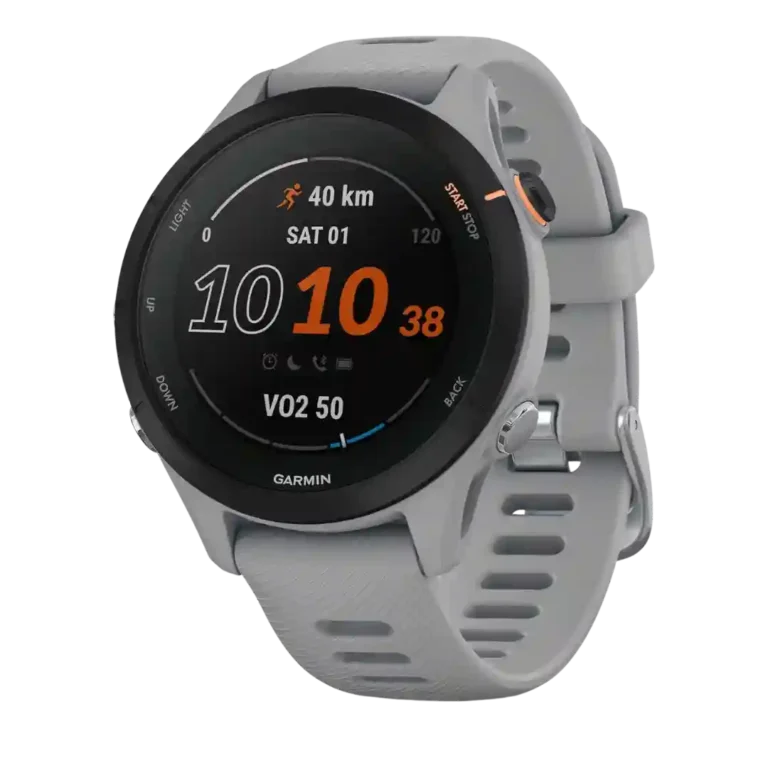
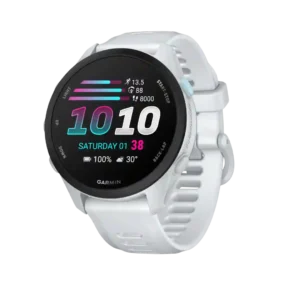
- More expensive: AMOLED touchscreen and newer software features The review frames the 255S as a cheaper alternative to the 265 if AMOLED and newer readiness features are not priorities.
Garmin Forerunner 255S Review
Bottom Line
Choose the Garmin Forerunner 255S for a compact, long-lasting GPS training watch with strong running and multisport tools. Skip it if you want AMOLED polish, a touchscreen, or rich smartwatch apps.
Best for runners, triathletes, hikers, swimmers, and smaller-wrist users who want strong GPS accuracy, long battery life, recovery insights, and practical training depth without a bulky flagship watch.
Not for shoppers who primarily want a stylish smartwatch with a touchscreen, AMOLED display, broad third-party apps, voice assistant features, or the most polished payment and phone interaction experience.
The Garmin Forerunner 255S earns its strongest praise as a compact training watch that gives smaller wrists serious Garmin depth: multiband GPS, strong battery life, broad workout tracking, useful coaching, and recovery metrics. Reviewers repeatedly found it comfortable enough for sleep and long sessions, with outdoor visibility that suits runs, hikes, rides, and swims. The tradeoff is clear: it feels more like a sport tool than a modern lifestyle smartwatch. The MIP screen helps battery and sunlight readability but lacks AMOLED color, there is no touchscreen, and Garmin’s menus can be dense for newcomers. Music, payments, notifications, and apps are useful extras, not the main reason to buy it.
Compared in Reviews
Products reviewers directly compared with this model, grouped into quick takeaways.
- Compared: runner-focused tracking alternatives The Polar Pacer Pro is presented as a similarly priced alternative with many comparable tracking features for runners.
Coros Pace 2
- Cheaper: sports tracking value The Coros Pace 2 is described as offering much of the 255S sports-tracking value for less money.
Feature Scorecards
Pros
-
Reliability is supported by long-term updates and GPS stability, with Garmin’s longevity praised in follow-up use.
-
Fit is excellent for smaller wrists, with the 41mm case repeatedly described as comfortable and well-sized.
-
Size options are a standout benefit because the 255S gives smaller wrists a serious multisport watch without losing core training tools.
-
Outdoor visibility is excellent because the MIP display remains readable in sunlight with very little glare.
-
Comfort is one of the strongest points, especially for sleep and long workouts, because the smaller case feels light and unobtrusive.
-
Workout variety is extensive, spanning running, cycling, swimming, hiking, yoga, triathlon and dozens of app-manageable workout types.
-
Water resistance is strong for swimming, rain and shower use, and physical buttons are an advantage around water.
-
Fitness tracking is broadly accurate and analysis-rich, especially for endurance training, with some caveats around live heart-rate smoothing.
-
The watch works across Android and iOS, with a consistent Garmin Connect experience, though Android gets better message response support.
-
Value is strong for runners and multisport users, especially given multiband GPS, battery life and training depth at a midrange price.
-
Reviewers consistently liked the silicone strap, calling it comfortable, adjustable, exercise-ready and tough enough for regular training use.
-
Customization is strong, covering workout data screens, watch faces, colors, app settings and per-activity tracking options.
-
Coaching features are a clear strength, with Garmin Coach, suggested workouts, race tools and personal-trainer-like prompts repeatedly highlighted.
-
Durability looks good in longer-term use, with reviewers reporting little wear, though the bezel and glass can still be scratch concerns.
-
Battery life is a major strength, commonly landing around a week or more, though music, GPS and oxygen monitoring can reduce it.
-
Recovery insights are a strong training feature, including HRV, Body Battery, Training Load and Morning Report-style readiness context.
-
Step counting appears accurate in the reviewer evidence, including a near-spot-on manual step check.
-
Heart-rate accuracy is generally strong for a wrist watch, often close to straps, but reviewers still recommend straps for the sharpest live accuracy.
-
Watch face support is good through built-in faces and Connect IQ, with reviewers noting customization and many free options.
-
Wellness insights such as Morning Report, Body Battery and general wellbeing metrics are useful companions to the training focus.
-
GPS accuracy is a major strength thanks to multiband GNSS, though a few reviewers saw small variations or altitude inaccuracies in specific scenarios.
-
The five-button layout is repeatedly praised for workouts, water use and avoiding accidental touches, even if it requires adjustment.
-
Build quality is generally solid for a lightweight polymer watch, with durable long-term impressions but some concern about scratch-prone Gorilla Glass.
-
Smartphone notifications work well for basic alerts and quick replies, especially on Android, but remain constrained by the small non-touch screen.
-
Blood oxygen tracking is present for sleep or daytime monitoring, but reviews treat it as one metric among many rather than a standout feature.
-
Smartwatch features are useful but intentionally basic, prioritizing training over app-rich Apple, Google or Samsung-style smartwatch polish.
-
Stress tracking is available as part of the broader health suite, with reviewers presenting it as a daily wellness metric.
-
Materials are typical Garmin Forerunner fare: lightweight polymer, Gorilla Glass and silicone, chosen more for sport practicality than luxury.
-
Music controls are present for phone audio, and the watch exposes quick music controls from the button interface.
-
Brightness control is handled through physical buttons and fits the watch’s practical, low-key outdoor design.
-
The MIP display is practical and readable rather than flashy, with reviewers trading away AMOLED vibrancy for battery life and outdoor usability.
-
The operating system is familiar and capable, with one reviewer praising its ease while others note Garmin’s learning curve.
-
Bluetooth headphone pairing is generally workable and music-friendly, though one long-term user found headphone pairing slow and frustrating.
-
Sleep tracking is viewed as useful and reasonably aligned with other devices, though not as deep as dedicated sleep-focused wearables.
-
Pairing and acquisition are mostly reliable, especially GPS and Bluetooth headphones, but headphone pairing frustrated one user.
-
Garmin Pay and NFC are supported and useful, but reviewers note Garmin’s payment system lacks the polish or bank support of rivals.
-
Health tracking is useful but training-oriented; reviewers appreciated HRV and recovery metrics while noting it is not a full health wearable.
-
Garmin Connect is useful and reliable for setup, syncing, visualization and customization, though music setup and app separation can confuse newcomers.
-
Onboard music is a useful feature with storage for offline audio, but setup and loading can be slow or confusing for some users.
-
The interface is powerful but polarizing: some find it easy once learned, while newcomers can find it dense or confusing.
-
Connect IQ adds watch faces, data fields and apps, but reviewers describe the ecosystem as useful rather than Apple-level and sometimes limited.
-
Call handling is basic: Android users can respond or reject calls through the watch, but it still relies heavily on the paired phone.
-
Safety features exist through optional Garmin tools such as LiveTrack, though the reviews provide limited evaluation beyond availability.
-
Style is utilitarian rather than flashy, but reviewers consider it acceptable for everyday wear if you choose muted colors.
Cons
-
Charging is functional but not premium; Garmin’s common cable is convenient for Garmin owners, while the proprietary setup feels dated to one reviewer.
-
Menu navigation is the clearest weakness, with several reviewers calling it complex or confusing despite button-control advantages.
-
Third-party app support exists through Connect IQ, Strava, Komoot and music apps, but reviewers describe it as limited versus mainstream smartwatches.
-
Touchscreen responsiveness scores poorly because the watch has no touchscreen; reviewers mostly frame that as a deliberate sport-watch tradeoff.
Compared With Category Average
Compared with other Smart Watch, this product is above average in size options, reliability, onboard music storage, below average in touchscreen responsiveness, menu navigation.
| Attribute | This product | Category average | Difference |
|---|---|---|---|
| touchscreen responsiveness | 1.0 | 3.7 | -2.7 |
| size options | 4.7 | 3.1 | +1.6 |
| reliability | 4.8 | 3.7 | +1.1 |
| menu navigation | 2.9 | 3.8 | -0.9 |
| onboard music storage | 3.7 | 2.8 | +0.9 |
| contactless payments | 3.8 | 2.8 | +0.9 |
| fit | 4.7 | 3.9 | +0.8 |
| cross-platform compatibility | 4.5 | 3.8 | +0.7 |
FAQ
Is the Garmin Forerunner 255S good for runners?
Yes. Reviewers repeatedly describe it as a strong runner-focused watch with accurate GPS, coaching tools, race widgets, suggested workouts, and deep training analysis.
How long does the battery last in real use?
Reviewers commonly saw about a week or more depending on GPS, music, and oxygen-tracking use. Music streaming, multiband GPS, and continuous blood oxygen monitoring drain it faster.
Does the Forerunner 255S have a touchscreen?
No. It uses five physical buttons, which reviewers liked for workouts, swimming, gloves, and avoiding accidental touches, though newcomers may need time to learn the menus.
Is the display easy to read outdoors?
Yes. Reviewers praised the memory-in-pixel display for sunlight readability, low glare, and always-on practicality, even though it is not as vibrant as AMOLED.
How accurate are GPS and heart-rate tracking?
GPS accuracy is one of the strongest themes, especially with multiband GNSS. Heart-rate tracking is generally strong for a wrist watch, but some reviewers still prefer a chest strap for high-intensity precision.
Are the music features worth it?
They can be useful for offline listening, with storage and supported services, but the reviews are mixed because setup, headphone pairing, and loading music can feel slow or confusing.
Is it a full smartwatch replacement?
Not really. It handles notifications, basic phone controls, Garmin Pay, music, weather, and apps, but reviewers frame it as a training watch first and a basic smartwatch second.
Consider This Instead
If you want better touchscreen responsiveness
Choose Coros Pace Pro. It scores 4.8 vs 1.0 for touchscreen responsiveness, with a 3.7 overall score.
If you want better third-party app support
Choose Samsung Galaxy Watch 8. It scores 4.8 vs 2.5 for third-party app support, with a 4.0 overall score.
If you want better menu navigation
Choose OnePlus Watch 3. It scores 4.6 vs 2.9 for menu navigation, with a 4.0 overall score.
If you want better charging convenience
Choose Suunto Vertical 2. It scores 4.5 vs 3.2 for charging convenience, with a 3.8 overall score.
Overall Top Smart Watch Alternatives
Good if you want the most rugged Apple Watch, brighter outdoor screen, better battery, LTE, and top apps. Skip it if you need Garmin-like mapping, recovery analytics, smaller sizing, or...
Pros: display quality, heart rate accuracy
Cons: cross-platform compatibility, recovery insights
Choose the Galaxy Watch 6 for a polished Android smartwatch with a bright screen, strong apps, and broad health tracking. Skip it if battery life, iPhone support, or full non-Samsung...
Pros: outdoor visibility, workout tracking variety
Cons: cross-platform compatibility, battery life
Good if you need a rugged Garmin with deep outdoor, tactical, GPS, training, and battery features. Skip it if you want a cheaper lifestyle watch or do not need the...
Pros: materials quality, durability
Cons: LTE connectivity, value for money
Good if you want premium golf maps, virtual caddie tools, health metrics, music, notifications, and long battery life in one watch. Skip it if you only need basic yardages or...
Pros: pairing reliability, brightness
Cons: software smoothness, user interface