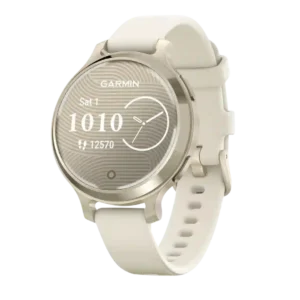
- Worse: battery life The Venu Sq 2 is described as lasting longer than the similarly priced Apple Watch SE.
Garmin Venu Sq 2 Review
Bottom Line
Choose the Garmin Venu Sq 2 if you want long battery life, accurate GPS and heart-rate tracking, and Garmin fitness tools. Skip it if you need richer apps, calls, voice assistant, ECG, LTE, or maps.
Best for fitness-focused buyers who want Garmin’s battery life, GPS accuracy, wellness metrics, and training tools in a lighter, lower-cost square watch. It especially suits casual runners, gym users, and people moving up from basic trackers.
Not for shoppers who want a true phone-like smartwatch with rich apps, calls from the wrist, voice assistant access, ECG, LTE, or full maps. Advanced endurance athletes may also miss training load, recovery status, courses, and deeper navigation.
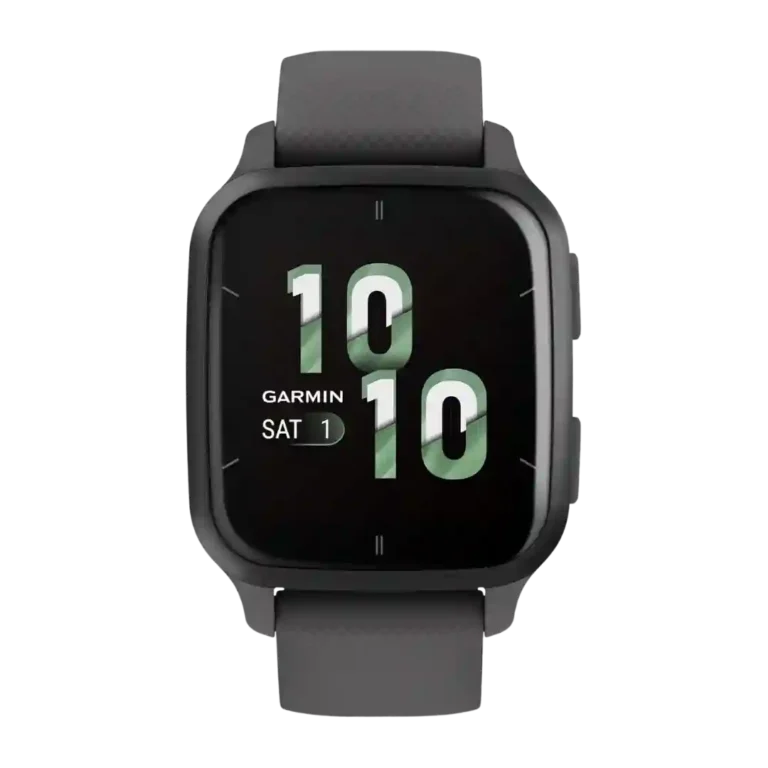
The Garmin Venu Sq 2 stands out as a fitness-first smartwatch with excellent battery life, accurate GPS, and strong heart-rate performance for everyday runners, gym users, and wellness-focused buyers. Reviewers consistently praise the AMOLED upgrade, lightweight comfort, Garmin Coach, Body Battery, and broad workout support. The tradeoff is that it behaves more like a capable fitness tracker than a full smartwatch: apps are limited, the interface can feel laggy or data-heavy, and it lacks calls, voice assistant support, ECG, LTE, richer mapping, and advanced recovery metrics. Its value is strongest for people who want Garmin’s tracking depth without paying for a premium Forerunner, Fenix, or Venu 2 Plus.
Compared in Reviews
Products reviewers directly compared with this model, grouped into quick takeaways.
- Worse: recorded stats reliability The review says the Venu Sq 2 records more reliable stats than the Fitbit Versa 4.
Galaxy Watch 5
- Better: smartwatch experience and app support The Galaxy Watch 5 is said to offer a more comprehensive smartwatch experience.
- Compared: price The Galaxy Watch 5 is positioned as a close price competitor around the same bracket.
Feature Scorecards
Pros
-
Charging speed is praised in one review, which says the watch charged from a low level to full in under 45 minutes.
-
Battery life is the clearest strength, with reviewers repeatedly reporting about nine to eleven days in normal smartwatch use and much less with always-on display.
-
Comfort is a consistent positive, with reviewers praising the light weight, slim case, 24/7 wearability, and ability to forget it is on the wrist.
-
Brightness is rated highly, with multiple reviewers saying the AMOLED screen is vibrant and readable outdoors or under direct sunlight.
-
Coaching features are strong for the price, especially Garmin Coach, downloadable workouts, training plans, and goal-based running or cycling support.
-
Cross-platform compatibility is a clear advantage, with reviewers noting support for both Android and iOS, unlike some platform-locked rivals.
-
Display quality is strongly praised after the move to AMOLED, with reviewers calling it bright, colorful, vibrant, sharp, and a major upgrade.
-
GPS accuracy is a major positive, with several reviewers reporting quick locks, accurate routes, and performance close to more expensive devices, aside from tougher city conditions.
-
Water resistance is well supported, with multiple reviewers noting 5ATM or 50-meter protection suitable for swimming and shower use.
-
Fitness tracking accuracy is strong overall, with GPS, heart-rate, sports, and exercise tracking often described as great, reliable, or close to reference devices.
-
Reliability is generally positive, especially for running-watch use and GPS chipset behavior, with reviewers calling it reliable or a solid option.
-
Heart-rate accuracy is mostly good to excellent, especially for steady workouts, though a few reviews note lag or higher max readings during harder intervals.
-
Wellness insights are a core strength, including Body Battery, stress, sleep score, SpO2, Health Snapshot, respiration, and energy-level guidance.
-
Workout tracking variety is broad for casual fitness, with more than 25 profiles, HIIT, yoga, swimming, running, cycling, and structured workouts.
-
Durability looks good for everyday use, with mentions of Gorilla Glass, aluminum, water resistance, and resistance to scuffs and scratches.
-
Bluetooth support is solid for sensors, headphones, and external heart-rate gear, with reviewers noting ANT+ and Bluetooth Smart accessory compatibility.
-
Outdoor visibility is generally good after the AMOLED upgrade, though one review still notes squinting in bright sun.
-
Value for money is strong for fitness-focused buyers thanks to battery, accuracy, and Garmin features, but weaker for shoppers wanting full smartwatch features or cheap pricing.
-
Touchscreen responsiveness is mostly good, with some reviewers calling it responsive and predictable, while others notice lag or less snappy motion.
-
Stress tracking is useful through HRV, stress widgets, and Relax Reminders, though one quote frames it as part of broader wellness logging.
-
The operating system experience is more Garmin-familiar and easier than the original Venu Sq, but still trails fuller smartwatch platforms.
-
Step counting is presented as a standard fitness-tracker feature, and one reviewer found step counts close to an Apple Watch comparison.
-
Only one review directly discusses automatic activity capture, saying the watch can credit elevated activity even without a manually started mode.
-
Music controls are useful on the base model for phone playback, while the Music Edition adds more independent playback options.
-
Smartphone notifications work well for alerts and basic viewing, but reply features depend on Android and richer notification actions are limited.
-
Safety features are a plus, including Assistance, Incident Detection, and LiveTrack, though phone pairing is required for some features.
-
Materials are practical rather than luxurious, with fiber-reinforced resin, aluminum trim, silicone straps, and a design carried over from the original.
-
Fit is generally good for smaller or average wrists, though one reviewer needed time for the silicone strap to settle around the wrist.
-
Button controls are usable but mixed: reviewers like glove-friendly physical buttons, while others find the two-button layout clunky or less intuitive.
-
Garmin Pay works and reviewers successfully used it, but support depends on banks and regions, so contactless payments are useful yet not universal.
-
Calorie tracking appears as part of Garmin’s basic daily fitness metrics and sport alerts, but reviewers focus more on steps, intensity minutes, and workouts.
-
Pairing support is present for Bluetooth headphones and accessories, but direct evidence is mostly about pairing capability rather than long-term reliability.
-
Sleep tracking is mixed to positive: timing is often accurate, but reviewers question stages, note no nap tracking, and mention occasional over-reporting.
-
Blood oxygen support is broadly present through SpO2 and Health Snapshot, though reviewers disagree on accuracy, with some readings described as low or unreliable.
-
The companion app is powerful and data-rich, but opinions split between clear presentation and complaints that Garmin Connect can feel buried or overwhelming.
-
Customization is broad through shortcuts, glances, data screens, and watch faces, though some watch-face configuration and shortcut limits feel awkward.
-
Menu navigation is divided: some reviewers find it simple and easy after learning it, while a critical review calls it slow and inconvenient.
-
Wi-Fi is available on the Music Edition for music syncing, while the base model is described as limited to Bluetooth and ANT+.
Cons
-
The user interface is basic but usable, with Garmin’s revised UI helping, though some reviewers still find the layout underused or plain.
-
Watch face quality is mixed: there are customizable and downloadable faces, but some reviewers dislike limited default customization and square-face support.
-
Build quality is functional but not premium; reviewers note lightweight construction and a useful aluminum bezel while criticizing the plasticky or cheaper feel.
-
Recovery insights are useful through Body Battery, but the watch lacks more advanced training readiness, load, and structured recovery metrics from higher Garmin models.
-
Reviewers describe Garmin’s Connect IQ ecosystem as useful for faces, widgets, and extras, but much smaller than Apple or Google-style app stores.
-
Charging convenience is mixed: the cable can plug in securely, but reviewers dislike the proprietary USB-A charger and Garmin-specific cable.
-
Health tracking accuracy is mixed: heart-rate and sleep timing can be good, but some reviewers question how meaningfully Garmin combines health data.
-
Onboard music storage is useful on the Music Edition but widely criticized as an upcharge, since the base model lacks storage.
-
Smartwatch features are serviceable but limited, with repeated criticism of missing calls, voice support, richer apps, and fuller phone-like functionality.
-
Band impressions are split: some reviewers found the silicone strap comfortable, while others called the bundled strap stiff or not especially comfortable.
-
Software smoothness is mixed, with several reviewers noticing lag, slow glances, or slower responsiveness than Apple or Samsung watches.
-
Third-party app support is limited; reviewers say Connect IQ has useful tools but pales beside Apple, Google, and Samsung app libraries.
-
Style and design are polarizing, with praise for wearability but repeated criticism that the square design is ordinary, cheaper-looking, or unattractive.
-
Size options are limited, as reviewers note a single 40mm case or no size differences between versions.
-
Mapping and navigation are basic; reviewers note only simple back-to-start or compass-style help, with no maps, breadcrumb trails, or course support.
-
Call handling is weak because reviews repeatedly state there is no Bluetooth call support, speaker, microphone, or Venu 2 Plus-style calling feature.
-
Voice assistant quality is poor because there is effectively no voice assistant support on the Venu Sq 2.
-
ECG functionality is absent; reviewers repeatedly state the Venu Sq 2 has no ECG feature and that Garmin ECG support was limited elsewhere.
-
LTE connectivity is not available; one reviewer directly says the watch lacks built-in LTE or cellular connection.
Compared With Category Average
Compared with other Smart Watch, this product is above average in contactless payments, below average in mapping and navigation, style and design, call handling.
| Attribute | This product | Category average | Difference |
|---|---|---|---|
| mapping and navigation | 1.9 | 3.7 | -1.8 |
| style and design | 2.4 | 4.2 | -1.8 |
| call handling | 1.6 | 3.1 | -1.5 |
| voice assistant quality | 1.5 | 2.7 | -1.1 |
| contactless payments | 3.8 | 2.8 | +1.0 |
| software smoothness | 2.9 | 3.9 | -1.0 |
| ECG functionality | 1.3 | 2.3 | -1.0 |
| size options | 2.2 | 3.2 | -0.9 |
FAQ
How long does the Garmin Venu Sq 2 battery last?
Reviewers commonly reported around nine to eleven days in regular smartwatch use. Always-on display and continuous sensors can cut that sharply, often into the two-to-three-day range.
Is the Garmin Venu Sq 2 accurate for workouts?
Most reviews found GPS and heart-rate tracking accurate for runs, rides, and general workouts. A few noted optical heart-rate lag during sudden spikes or harder interval sessions.
Does the Venu Sq 2 support calls or a voice assistant?
No. Reviewers repeatedly note that it lacks a speaker, microphone, Bluetooth calling, and voice assistant support.
Can it store music on the watch?
Only the Music Edition stores music offline. Several reviewers liked offline Spotify support, but many criticized Garmin for charging extra for that storage.
Is Garmin Connect easy to use?
Garmin Connect is deep and highly customizable, with lots of data and trends. Some reviewers liked the detail, while others found settings buried or the app overwhelming for newcomers.
Is it good for sleep and wellness tracking?
It offers sleep score, stress, Body Battery, respiration, SpO2, and Health Snapshot. Reviewers generally liked the wellness tools, but sleep stages, naps, and some SpO2 readings drew caveats.
Consider This Instead
If you want better ECG functionality
Choose Apple Watch Series 11. It scores 4.5 vs 1.3 for ECG functionality, with a 4.2 overall score.
If you want better call handling
Choose Apple Watch Series 10. It scores 4.6 vs 1.6 for call handling, with a 4.2 overall score.
If you want better mapping and navigation
Choose Garmin Epix Pro (Gen 2). It scores 4.8 vs 1.9 for mapping and navigation, with a 4.1 overall score.
If you want better size options
Choose Garmin Approach S70. It scores 4.7 vs 2.2 for size options, with a 4.3 overall score.
Overall Top Smart Watch Alternatives
Good if you want the most rugged Apple Watch, brighter outdoor screen, better battery, LTE, and top apps. Skip it if you need Garmin-like mapping, recovery analytics, smaller sizing, or...
Pros: display quality, heart rate accuracy
Cons: cross-platform compatibility, recovery insights
Choose the Galaxy Watch 6 for a polished Android smartwatch with a bright screen, strong apps, and broad health tracking. Skip it if battery life, iPhone support, or full non-Samsung...
Pros: outdoor visibility, workout tracking variety
Cons: cross-platform compatibility, battery life
Good if you need a rugged Garmin with deep outdoor, tactical, GPS, training, and battery features. Skip it if you want a cheaper lifestyle watch or do not need the...
Pros: materials quality, durability
Cons: LTE connectivity, value for money
Good if you want premium golf maps, virtual caddie tools, health metrics, music, notifications, and long battery life in one watch. Skip it if you only need basic yardages or...
Pros: pairing reliability, brightness
Cons: software smoothness, user interface