- Better: iPhone smartwatch experience The Apple Watch SE is described as a slicker choice for iPhone users.
- Better: app selection and connectivity The Apple Watch SE is presented as stronger for apps and connectivity than the Versa 4.
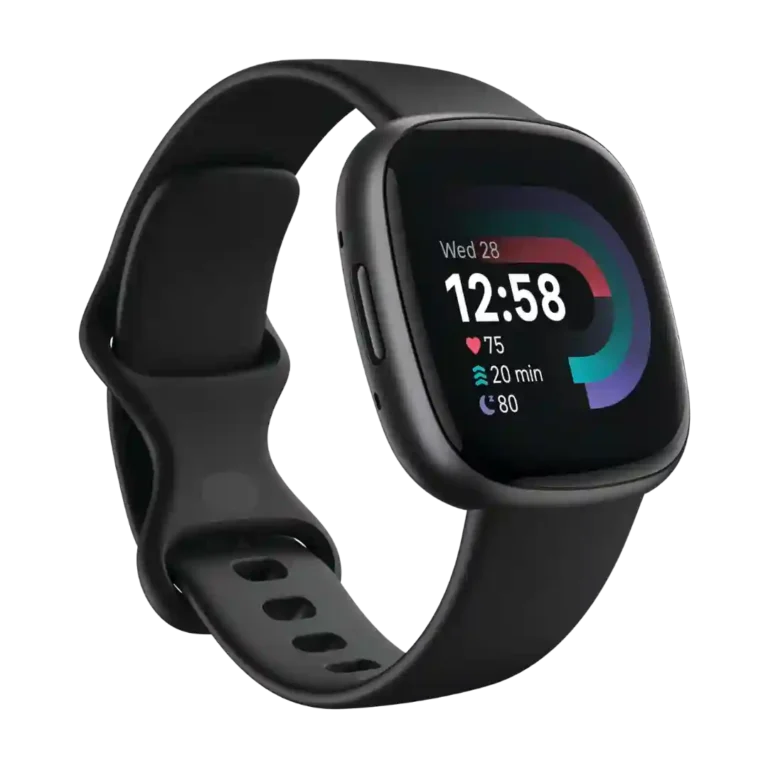
Fitbit Versa 4 Review
Bottom Line
Choose the Versa 4 for long battery life, comfort, sleep tracking, and simple fitness tools. Skip it for robust apps, music, LTE, ECG, or high-intensity heart-rate accuracy.
Best for casual fitness users who want a comfortable Fitbit with multi-day battery life, sleep tracking, simple workout tools, and readable notifications. It also suits buyers who value Fitbit’s app and do not need a full app-store smartwatch.
Not for serious athletes who need precise heart-rate response, rich running metrics, or advanced GPS analysis. It is also a poor fit for users who want third-party apps, music storage, LTE, ECG, or deep iPhone/Android smartwatch integration.
Reviewers frame the Fitbit Versa 4 as a comfortable fitness-first watch with long battery life, a bright display, simple navigation, and useful sleep and daily activity tracking. Its strongest everyday appeal is low upkeep: many reviewers got several days between charges, and the lightweight case is easy to wear overnight. The tradeoff is that it behaves more like a polished fitness tracker than a full smartwatch. Third-party apps, music support, Wi-Fi usefulness, ECG hardware, and richer phone integration are repeatedly missing or limited. Fitness tracking is solid for casual use, but heart-rate spikes and GPS lock or route precision drew enough criticism to make it less convincing for serious training.
Compared in Reviews
Products reviewers directly compared with this model, grouped into quick takeaways.
- Better: heart rate accuracy The Versa 4’s heart-rate readings were lower than the Apple Watch Ultra in testing.
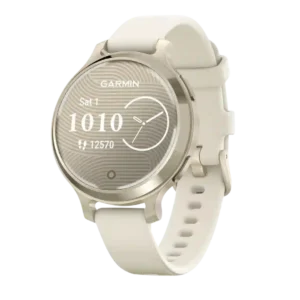
- Better: wellness and performance insights The Garmin Venu Sq 2 is treated as the stronger overall pick for insights.
Feature Scorecards
Pros
-
Brightness drew consistent praise, with reviewers calling the AMOLED screen bright indoors, outdoors, and in high-brightness conditions.
-
Pairing and syncing reliability was split between seamless experiences and complaints about slow sync or Bluetooth dependence.
-
The physical side button was one of the clearest upgrades, repeatedly praised as easier and more reliable than the Versa 3’s capacitive control.
-
Comfort was a major strength, with reviewers repeatedly saying the Versa 4 is light, easy to wear all day, and comfortable for sleep tracking.
-
Fit was viewed positively, with reviewers saying the watch sits flush, has a lower profile, and includes band options that improve comfort.
-
Outdoor visibility was strong overall, with multiple reviewers saying the screen stayed readable outdoors or in bright environments.
-
Display quality was widely praised for a bright, colorful AMOLED panel with clear text and enough size to read notifications comfortably.
-
Build quality was described positively overall, with reviewers pointing to the slim body, premium-feeling materials, and exceptional construction for the price.
-
Style and design were widely positive, with reviewers liking the slim, sleek, lightweight look and Fitbit’s recognizable square shape.
-
Watch face quality is good in variety, with hundreds or many faces mentioned, but customization depth is weaker than on some rivals.
-
Size options are good in the box, with small and large straps included for a wide wrist range.
-
Sleep tracking was one of the most praised tracking areas, with several reviewers calling it accurate, useful, or among Fitbit’s best strengths.
-
Water resistance is strong for everyday fitness use, with reviewers consistently citing 50m/5ATM protection for swimming or showering.
-
The user interface was mostly praised as simple, intuitive, and easy to understand, even by reviewers who disliked the broader smartwatch limitations.
-
Battery life is one of the strongest areas, with most reviewers reporting several days to about a week depending on GPS and always-on display use.
-
Bands were generally comfortable and easy to swap, though one reviewer noted the default band could cause irritation if worn continuously.
-
Workout tracking variety is strong, with reviewers consistently noting over 40 modes, though several said many modes remain shallow or generic.
-
Materials quality was generally positive, with reviewers citing aluminum, premium-feeling casing, and better manufacturing for the price.
-
Contactless payments are supported through Fitbit Pay or Google Pay/Wallet, and reviewers generally described setup or use as straightforward.
-
Charging speed was usually seen as good for quick top-ups, though multiple reviews still noted a full charge can take about two hours.
-
Blood oxygen tracking is present through SpO2/oxygen saturation readings, usually discussed as part of overnight health metrics rather than as a headline feature.
-
Safety features include irregular rhythm and atrial fibrillation alerts, but reviewers described them as background safeguards rather than advanced medical tools.
-
Step counting ranged from very accurate in one hands-on test to short-counting in another, making this attribute positive but not unanimous.
-
Fitness tracking accuracy is acceptable for casual use, but reviewers disagreed on precision and found it less robust for serious performance tracking.
-
GPS accuracy was mixed: some reviewers found it quick and accurate, while others saw slow lock-on, vague routes, or inconsistent performance.
-
Charging convenience was mixed: reviewers liked the magnetic connector and reminders, but noted the proprietary cable and missing wall adapter drawbacks.
-
Touchscreen responsiveness was divided: some reviewers praised improved or smooth touch input, while others found lag, jumpiness, or slow wake behavior.
-
General health tracking is broad and useful for trends, but reviewers cautioned that missing sensors and variable accuracy limit advanced health claims.
-
Coaching features are useful for simple goals and Active Zone Minutes, but less satisfying for structured athletes who want richer workout guidance.
-
Menu navigation is mostly simple and understandable, helped by tiles and the physical button, though some testers found the swipe menus inefficient.
-
Cross-platform support exists for iPhone and Android, but iPhone users get weaker reply and integration options than Android users.
-
Recovery insights are useful through Daily Readiness and related trends, but reviewers repeatedly noted key readiness features require Premium.
-
Calorie tracking appears in daily summaries and goal tools, but reviewers treated it as a supporting metric, with one calling calorie estimates vague.
-
Smartphone notifications are readable and useful, but replies and voice/text features are more limited on iPhone than Android.
-
Wellness insights are useful for sleep, readiness, and health trends, but multiple reviewers criticized important insights being locked behind Premium.
-
The operating system is approachable and Fitbit-like, but reviewers saw it as more limited than Wear OS and sometimes too stripped back.
-
The Fitbit companion app drew mixed reactions: some praised its clean, intuitive layout, while others reported slow syncing, crashes, or Premium nudges.
-
Stress tracking exists through scores, breathing, and related metrics, but reviewers noted the missing EDA sensor limits deeper stress analysis.
-
Auto-detection was inconsistent: one reviewer found SmartTrack reliable for walks, while others reported failed auto-logging or a delayed detection window.
-
Bluetooth is necessary for many smart features; some reviewers praised improved range, while others reported unreliable iPhone Bluetooth behavior or phone dependence.
Cons
-
Software smoothness varied: some reviewers saw improvement or slight pauses only, while others reported lag when swiping or moving through screens.
-
Maps/navigation is useful but limited: reviewers mentioned Google Maps support, while noting phone dependence and no full map view.
-
Reliability was mixed: some reviewers had seamless use, while others described sync glitches, random workout failures, or inconsistent behavior.
-
Call handling is present but limited: some reviewers found wrist calls workable, while others noted poor audio or launch-time gaps.
-
Voice assistant quality is mixed because Alexa is available and sometimes useful, but Google Assistant is absent and speaker quality can be poor.
-
Customization is decent through straps and many watch faces, but reviewers noted watch-face customization is more limited than rival platforms.
-
Value for money was mixed: long battery life and fitness basics help, but limited smartwatch features made several reviewers recommend alternatives.
-
Heart rate accuracy was the most repeated tracking concern, especially during spikes, intervals, and higher-intensity exercise.
-
Smartwatch features are the Versa 4’s weakest identity point, with many reviewers saying it behaves more like a fitness tracker than a true smartwatch.
-
The app ecosystem is a repeated weakness because reviewers found the Versa 4 stripped back, with no real app store or third-party app downloads.
-
ECG functionality is absent on the Versa 4, a repeated contrast with Sense models and some cheaper Fitbit alternatives.
-
Music controls were a major weakness because reviewers repeatedly said music control, Spotify, or playback support had been removed or was missing.
-
Third-party app support is essentially absent, and reviewers repeatedly framed this as one of the Versa 4’s biggest downgrades.
-
Wi-Fi connectivity is a clear weakness because reviewers said Wi-Fi is removed, disabled, dormant, or unavailable.
-
Onboard music storage is effectively absent, with reviewers saying users cannot store music or download listening content for phone-free runs.
-
LTE or cellular connectivity is not available, so connected features depend on a nearby phone.
Compared With Category Average
Compared with other Smart Watch, this product is above average in contactless payments, below average in music controls, app ecosystem, third-party app support.
| Attribute | This product | Category average | Difference |
|---|---|---|---|
| music controls | 1.0 | 3.5 | -2.5 |
| app ecosystem | 1.3 | 3.6 | -2.3 |
| third-party app support | 1.0 | 3.1 | -2.1 |
| Wi-Fi connectivity | 1.0 | 3.2 | -2.2 |
| onboard music storage | 1.0 | 2.9 | -1.9 |
| smartwatch features | 1.9 | 3.6 | -1.7 |
| heart rate accuracy | 2.5 | 3.9 | -1.4 |
| contactless payments | 4.2 | 2.8 | +1.3 |
FAQ
Is the Fitbit Versa 4 a full smartwatch?
Reviewers repeatedly say it is closer to a polished fitness tracker than a full smartwatch. It handles basics like notifications, payments, Alexa, and some Google features, but app and music support are heavily limited.
How good is the battery life?
Battery life is one of the Versa 4’s strongest areas. Reviewers commonly reported several days per charge, though always-on display, GPS, and heavy use reduce runtime.
Is the Fitbit Versa 4 accurate for workouts?
It is generally fine for casual exercise tracking, steps, distance, and basic workouts. Reviewers were much less confident about heart-rate accuracy during high-intensity sessions and mixed on GPS lock and route precision.
Does the Versa 4 support music apps or onboard music?
No, reviewers repeatedly noted that music controls, Spotify support, and onboard music storage were removed or missing. For phone-free workouts with music, that limitation was a major drawback.
How is sleep tracking on the Versa 4?
Sleep tracking is one of the best-reviewed features. Several reviewers found it accurate or useful, although deeper sleep insights and profiles may require Fitbit Premium.
Does the Versa 4 have ECG or LTE?
No. Reviewers consistently noted that ECG is missing, and one review explicitly stated Fitbit watches do not have cellular support, so connected features rely on a nearby phone.
Who should consider a different watch?
Consider another watch if you want a true smartwatch app ecosystem, music support, advanced health sensors, richer coaching, or more dependable high-intensity heart-rate tracking.
Consider This Instead
If you want better music controls
Choose Apple Watch SE 3. It scores 4.8 vs 1.0 for music controls, with a 4.1 overall score.
If you want better third-party app support
Choose Samsung Galaxy Watch 8. It scores 4.8 vs 1.0 for third-party app support, with a 4.0 overall score.
If you want better app ecosystem
Choose Apple Watch Ultra 3. It scores 4.9 vs 1.3 for app ecosystem, with a 4.2 overall score.
If you want better onboard music storage
Choose Huawei Watch Fit 4. It scores 4.7 vs 1.0 for onboard music storage, with a 4.1 overall score.
Overall Top Smart Watch Alternatives
Good if you want the most rugged Apple Watch, brighter outdoor screen, better battery, LTE, and top apps. Skip it if you need Garmin-like mapping, recovery analytics, smaller sizing, or...
Pros: display quality, heart rate accuracy
Cons: cross-platform compatibility, recovery insights
Choose the Galaxy Watch 6 for a polished Android smartwatch with a bright screen, strong apps, and broad health tracking. Skip it if battery life, iPhone support, or full non-Samsung...
Pros: outdoor visibility, workout tracking variety
Cons: cross-platform compatibility, battery life
Good if you need a rugged Garmin with deep outdoor, tactical, GPS, training, and battery features. Skip it if you want a cheaper lifestyle watch or do not need the...
Pros: materials quality, durability
Cons: LTE connectivity, value for money
Good if you want premium golf maps, virtual caddie tools, health metrics, music, notifications, and long battery life in one watch. Skip it if you only need basic yardages or...
Pros: pairing reliability, brightness
Cons: software smoothness, user interface