
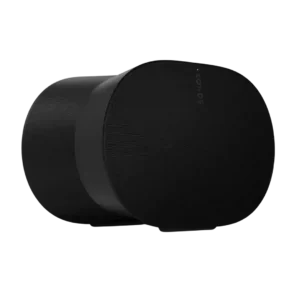
Review: Sonos Era 300 Speaker
Updated: 3 weeks ago
4.3
Based on methodology below
283
Insights analyzed
28
Grouped by key features
20
From expert reviews
Scores below reflect consolidated expert coverage across these features.
Bottom Line
Choose the Era 300 for expansive Dolby Atmos sound, strong Sonos ecosystem flexibility, and excellent home theater upside. Skip it if you mainly want cheap stereo playback or need Google Assistant, Chromecast, or included wired adapters.
Best for
Listeners who want a premium all-in-one speaker that can handle immersive music today and grow into a larger Sonos setup later. It especially suits medium-to-large rooms, stereo pairs, and Arc-based home theater builds.
Not for
Buyers who mostly stream standard stereo on a budget, need Google Assistant or Chromecast, or hate buying extra adapters for line-in and Ethernet should look elsewhere. It is also a weaker fit for cramped shelves or very small rooms.
Verdict
The Era 300 stands out because it sounds unusually big, detailed, and immersive for a single wireless speaker, and it becomes even more compelling once you add a second unit or fold it into a Sonos theater system. Its best performances come from good placement, strong Atmos mixes, and the broader Sonos ecosystem. The tradeoff is that some of its headline appeal depends on services and workflows that are still a little messy, especially if you rely on Spotify, Google features, or cheap wired hookups. If those caveats do not apply, it is one of the most complete premium all-in-one speakers in this class.
Pros
-
5.0based on 3 reviewsCohesive presentation: 5.0, based on 3 reviewsWhen the Era 300 is working well, reviewers describe the sound as unusually solid and unified rather than artificially stretched apart. That sense of cohesion is a big reason its spaciousness feels believable.
-
4.9based on 5 reviewsSurround sound simulation: 4.9, based on 5 reviewsAs a surround or Atmos-effect speaker, the Era 300 creates a notably convincing bubble of sound with better rear and height steering than earlier Sonos options. The effect is strongest in paired or soundbar-based setups.
-
4.9based on 7 reviewsSmart features: 4.9, based on 7 reviewsAs a feature package the Era 300 is exceptionally versatile, combining Wi-Fi, Bluetooth, voice control, Trueplay, multiroom, and multiple configuration paths. The only major omissions repeatedly mentioned are Google features and included adapters.
-
4.7based on 10 reviewsDetail retrieval: 4.7, based on 10 reviewsDetail retrieval is one of the most consistently praised traits, with reviewers highlighting crisp vocals, layered instruments, and strong separation. Many described it as more revealing and refined than key rivals.
-
4.7based on 18 reviewsSoundstage height: 4.7, based on 18 reviewsHeight and vertical scale are core selling points, and the reviews overwhelmingly agree the Era 300 delivers unusually convincing elevation cues for a one-box speaker. The effect becomes even more dramatic in stereo pairs or surround systems.
-
4.6based on 4 reviewsInter-speaker connectivity: 4.6, based on 4 reviewsWhen used with other Sonos gear, the Era 300 generally integrates seamlessly and helps create a more unified soundfield. Reviewers especially praised how well it hands off effects within Arc-based theater systems.
-
4.6based on 17 reviewsHome theater integration: 4.6, based on 17 reviewsHome theater use is a standout strength. As rears with an Arc or Beam Gen 2, the Era 300 adds much stronger height, side, and rear effects than earlier Sonos speakers.
-
4.5based on 15 reviewsLoudness / maximum volume: 4.5, based on 15 reviewsThe Era 300 plays much larger than its footprint suggests, with enough output to fill medium and large rooms. Several reviewers still preferred adding a Sub for maximum scale, but raw loudness was rarely treated as a weakness.
-
4.5based on 9 reviewsPrivacy and data: 4.5, based on 9 reviewsPrivacy provisions are stronger than usual for a smart speaker, with a physical mic kill switch and frequent mentions of local processing for Sonos Voice Control. Reviewers generally treated this as a meaningful positive.
-
4.5based on 5 reviewsDistortion at high volume: 4.5, based on 5 reviewsAt higher volumes the Era 300 stays composed, with reviewers repeatedly praising its ability to remain clean and avoid obvious strain. A few noted that DSP reins in the deepest bass before audible distortion becomes a problem.
-
4.5based on 2 reviewsWi-Fi streaming reliability: 4.5, based on 2 reviewsWhere explicitly discussed, Wi-Fi streaming was stable and stronger than older Sonos generations, with Wi-Fi 6 helping reduce earlier dropout concerns. It remains a Wi-Fi-first product that benefits from a solid home network.
-
4.4based on 6 reviewsOn-device controls: 4.4, based on 6 reviewsTop-panel controls are easy to use, with the recessed volume slider earning especially positive feedback. Reviewers generally found the touch interface more intuitive than older Sonos control layouts.
-
4.4based on 12 reviewsMulti-speaker pairing reliability: 4.4, based on 12 reviewsGrouping and stereo pairing are usually described as simple and dependable, and several reviewers praised how naturally the speaker folds into larger Sonos systems. A few noted extra friction when moving paired speakers between roles.
-
4.3based on 16 reviewsFrequency response balance: 4.3, based on 16 reviewsThe tonal balance is generally mature and clear, with solid bass, open mids, and crisp treble. Minor caveats recur around lighter deepest bass, occasional boom depending on placement, and an unforgiving nature with rough recordings.
-
4.3based on 12 reviewsBluetooth connection stability: 4.3, based on 12 reviewsBluetooth was a welcome addition and was mostly described as fast, straightforward, and reliable once paired. Its main limitation is feature scope, since Atmos does not play over Bluetooth.
-
4.2based on 10 reviewsStereo imaging accuracy: 4.2, based on 10 reviewsStereo imaging is a major strength, especially in pairs, with strong center focus and wide separation. As a single speaker it is still spacious, though a few reviewers found stereo less precise than Atmos playback or dedicated stereo designs.
-
4.2based on 15 reviewsAudio format support: 4.2, based on 15 reviewsThe Era 300 handles stereo, high-res, and Dolby Atmos well, but its headline Atmos support is still constrained by service compatibility and app-based playback. That keeps format support strong overall rather than completely frictionless.
-
4.1based on 14 reviewsSetup simplicity: 4.1, based on 14 reviewsInitial setup is usually fast and friendly, helped by strong onboarding and Trueplay options. The main cautions are account requirements, Wi-Fi dependence, and occasional stereo-pair or advanced-tuning quirks.
-
4.1based on 11 reviewsAirPlay compatibility: 4.1, based on 11 reviewsAirPlay 2 support makes the Era 300 easy to use for Apple households and TV audio workarounds. The main limitation is that Atmos playback does not travel over AirPlay, so convenience is high even if capability is not complete.
-
4.1based on 4 reviewsVoice assistant responsiveness: 4.1, based on 4 reviewsWhen reviewers discussed direct voice use, response speed was usually quick and practical for playback commands. Performance is best for simple music tasks rather than deep assistant ecosystems.
-
4.1based on 5 reviewsEQ customization: 4.1, based on 5 reviewsEQ options are useful rather than exhaustive, with bass, treble, loudness, and height adjustments giving enough control for most rooms. Power users may still want deeper tuning.
-
4.1based on 19 reviewsValue for money: 4.1, based on 19 reviewsMost reviews ultimately say the Era 300 earns its premium with sound quality and system flexibility, even if it is not cheap. Value drops for buyers who will not use spatial audio, Sonos expansion, or its broader feature set.
-
3.8based on 14 reviewsDesign and aesthetics: 3.8, based on 14 reviewsThe hourglass cabinet is divisive: many reviewers warmed to it over time and appreciated the premium build, while others never loved the look or found placement awkward. The design is functional first and decorative second.
-
3.7based on 17 reviewsWired input: 3.7, based on 17 reviewsThe Era 300 supports line-in and optional Ethernet, but reviewers repeatedly disliked having to buy separate adapters. Availability is better than older Sonos speakers in practice, yet the implementation feels incomplete at this price. Line-in playback is widely considered very good, with vinyl and other analog sources benefiting from the speaker's spacious presentation. Several reviewers specifically liked how open, warm, or low-latency wired playback sounded.
-
3.7based on 3 reviewsLow-volume performance: 3.7, based on 3 reviewsLow-volume behavior is respectable but not class-leading. Some reviewers appreciated loudness support, while others felt the speaker sounds less full or energetic when played quietly.
-
3.5based on 10 reviewsApp reliability: 3.5, based on 10 reviewsThe Sonos app remains powerful for setup, grouping, and multiroom control, but the review set is mixed on day-to-day polish. Atmos discovery and search are recurring pain points, and some reviewers called the app slow or clumsy.
Cons
-
3.2based on 14 reviewsSmart assistant integration (Alexa: 3.2, based on 14 reviewsAlexa and Sonos Voice Control are useful, but the missing Google Assistant or Chromecast support is one of the most common complaints. Buyers in Apple- or Alexa-heavy homes are better served than Google-centric users.
FAQ
Is the Sonos Era 300 good for regular stereo music, or is it mainly for Dolby Atmos?
It is very good with standard stereo music and many reviewers praised its scale, detail, and tonal balance even without Atmos. Atmos is the differentiator, but the speaker is not a one-trick gimmick.
Do you need two Era 300 speakers to enjoy them?
No. One speaker already throws a surprisingly large soundfield, but a second unit unlocks better stereo imaging, more scale, and a more convincing immersive effect.
Does Dolby Atmos music work over Bluetooth or AirPlay?
No. The review set consistently says Atmos playback is tied to supported services through the Sonos ecosystem, while Bluetooth and AirPlay are mainly for standard playback convenience.
Is the Era 300 worth buying without a Sonos soundbar?
Yes, if you want a premium standalone music speaker with strong expansion options later. The value is lower if you will never use spatial audio, multiroom features, or a future Sonos theater upgrade.
Reviews we analyzed
Video Reviews
![Sonos Era 300 In-Depth Review - Should YOU Buy It? [2023]](https://servicedig.com/wp-content/uploads/2026/03/19628_thumb-150x150.webp "Sonos Era 300 In-Depth Review - Should YOU Buy It? [2023]")



Article Reviews





Best Speakers
#1

4.5
Choose the REN if you want a stylish, plug-and-play stereo alternative to a soundbar with excellent inputs and imaging. Skip it if you...
Pros: Wired input availability, HDMI ARC), Home theater integration, Bluetooth connection stability, Cohesive presentation, Dialogue clarity (for TV/soundbar use), Stereo imaging accuracy
Cons: none
#2

4.5
Choose the HW-Q990F for blockbuster-style, room-filling Atmos from an easy four-piece kit; Skip it if you are chasing the best dialogue and music...
Pros: Audio format support, Cohesive presentation, AirPlay compatibility, Latency with TV (lip sync), HDMI 2.1 gaming, Video passthrough support, Chromecast compatibility
Cons: none
#3
4.4
Choose the HW-Q990D if you want a huge Dolby Atmos bubble plus HDMI 2.1 passthrough for PS5/Xbox. Skip it if you don’t need...
Pros: Multi-speaker pairing reliability, Audio format support, Loudness / maximum volume, Video passthrough support, Surround sound simulation, HDMI ARC), Cohesive presentation
Cons: Status indicators
#4
4.4
Choose the LSX II for compact wireless speakers with standout imaging and flexible streaming. Skip if you need deep bass or large-room volume...
Pros: Wired input availability, Latency with TV (lip sync), Setup simplicity, Design and aesthetics, Stereo imaging accuracy, Cohesive presentation, Audio format support
Cons: On-device controls, Remote control usability