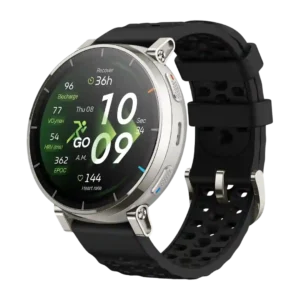
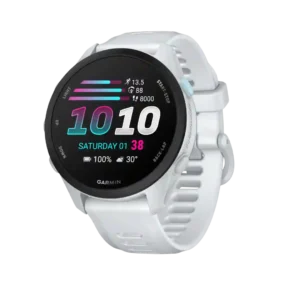
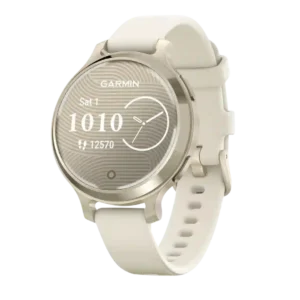
- Compared: feature depth versus price The reviewer found the T-Rex 3 surprisingly strong in some details while still behind the Fenix ecosystem for pro adventurers.
- Better: overall flagship positioning and navigation maturity The reviewer rejected the idea that the T-Rex 3 matches Garmin Fenix-level capability.
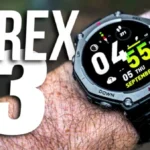
Amazfit T-Rex 3 Review
Bottom Line
Choose the Amazfit T-Rex 3 for long battery life, strong GPS, a bright rugged display, and lots of sports modes at a low price. Skip it if you need polished maps, reliable readiness scores, calls, or a smaller all-day fit.
Best for budget-minded hikers, runners, and outdoor users who want rugged hardware, long battery life, accurate GPS, offline maps, and many sport modes without paying flagship prices.
Not for users who need a smaller watch, polished route planning, phone calls, broad contactless payments, streaming music, or highly trusted readiness and heart-rate data for serious training decisions.
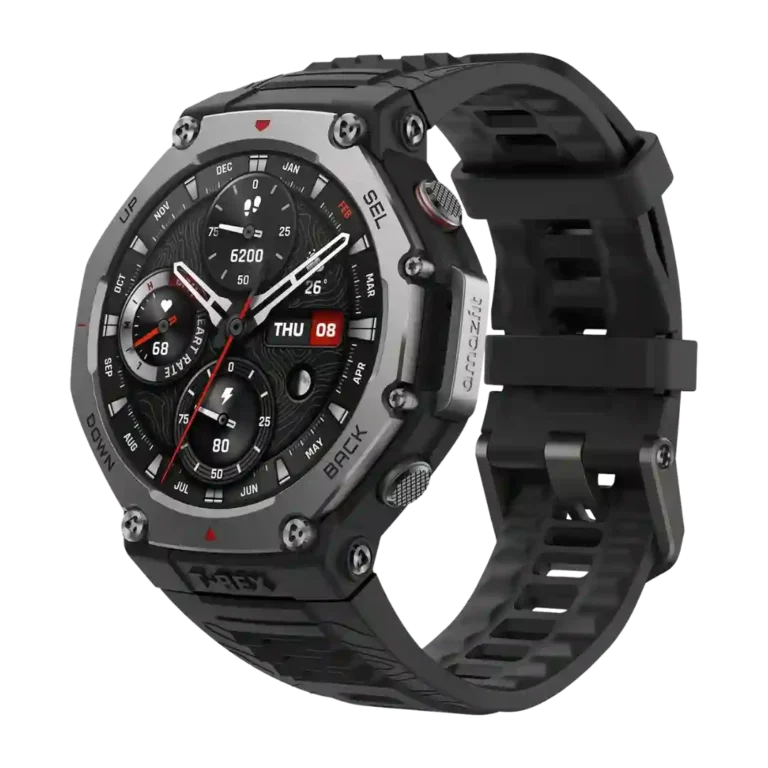
Across the reviews, the Amazfit T-Rex 3 stands out as a rugged adventure watch with exceptional value: reviewers repeatedly praised its battery life, bright AMOLED display, broad sport profiles, solid GPS, and durable construction. Its tradeoff is polish. The watch has premium-looking features such as maps, voice control, payments, recovery scores, and app support, but several reviewers found those features uneven, clumsy, or limited compared with Garmin, Apple, Coros, and Suunto alternatives. Fit is also divisive because the large case and strap can feel bulky or uncomfortable, especially for smaller wrists or sleep tracking. It works best as a budget outdoor and fitness watch, not as a refined flagship smartwatch or serious dive computer.
Compared in Reviews
Products reviewers directly compared with this model, grouped into quick takeaways.
- Better: map quality The reviewer said a comparable Coros watch offers better maps, though with different smartwatch tradeoffs.
- Alternative: bulk and value The Suunto Race was suggested as a smaller alternative if the T-Rex 3 feels too bulky.
Feature Scorecards
Pros
-
Water resistance is a clear strength, with 10ATM/100m ratings and recreational dive or freedive support repeatedly cited.
-
Workout variety is exceptional, with reviewers repeatedly citing more than 170 or 177 activity modes across conventional and niche sports.
-
Value is the strongest consensus point: reviewers repeatedly called it outstanding, fantastic, or incredible for the feature set and price.
-
Brightness is a clear strength, with multiple reviewers praising the 2,000-nit AMOLED screen and its vivid, readable output.
-
Outdoor visibility is a major strength, with reviewers finding the AMOLED screen easy to read in bright outdoor conditions and direct sunlight.
-
Battery life is one of the strongest areas, with reviewers reporting roughly a week to multiple weeks depending on settings and long GPS endurance for outdoor use.
-
Display quality is broadly praised for size, AMOLED color, brightness, and readability, though a few reviewers noted it is not quite best in class.
-
Durability is a strong point, with reviewers reporting rugged construction, outdoor testing without damage, and good resilience in rocky conditions.
-
GPS accuracy is consistently strong across reviews, with clean tracks, solid route matching, and good results even in challenging outdoor settings.
-
Software smoothness is usually praised for fast menus and responsive scrolling, though maps and gesture wake can still show slowdowns.
-
Customization is strong across shortcut cards, data screens, strap adapters, route colors, and watch settings.
-
The watch is generally described as rugged and solid, using a stainless steel bezel and polymer body, though its affordable materials are not uniformly premium.
-
The user interface earns praise for speed and Garmin-like logic, but reviewers who dislike complexity found the watch less beginner-friendly.
-
Physical buttons are a real advantage for workouts and glove use, though one reviewer found the buttons did not always integrate seamlessly with menus.
-
Design is bold and rugged, with G-Shock-like or hexagonal styling that some reviewers liked and others found oversized or loud.
-
Blood oxygen tracking is consistently present as part of the health sensor suite, usually mentioned alongside HRV, skin temperature, and stress monitoring rather than deeply tested.
-
Core fitness tracking generally lands well for casual and outdoor use, though some areas still need refinement compared with higher-end sports watches.
-
Music controls are available and useful for phone playback, but they are part of a limited smartwatch feature set.
-
Smartphone notifications are supported on both platforms, with mirrored notifications and some reply options, but platform limits remain.
-
Wellness insights are broad and accessible, including health assessments and readiness guidance, but their usefulness depends on trust in the underlying scores.
-
Wi-Fi is used for map downloads and works for large offline map transfers, but it is mostly a utility feature rather than a broader smartwatch connectivity strength.
-
Step counting matched Garmin closely in the available direct comparison, though it was not widely tested across reviews.
-
Stress tracking is included with the broader health suite and tied to newer sensors, but reviewers mostly discussed availability rather than validating accuracy.
-
Watch faces are generally liked or well executed, though taste varies and evidence is less central than display or interface quality.
-
Touchscreen responsiveness is generally good for swipes, taps, and map interaction, though gesture wake and some map modes remain inconsistent.
-
The watch works with both Android and iOS, but reviewers noted platform-specific limitations, especially around replies and smart features.
-
Bluetooth support is broad, including heart-rate straps and cycling sensors, but some reviewers noted incomplete support or uneven sensor behavior.
-
Calorie tracking is available and was close to comparison watches in one review, but most evidence treats it as a basic metric rather than a major decision driver.
-
Health tracking accuracy is mixed: many individual metrics look plausible, but broader health and wellness scoring is less consistently trusted.
-
Band feedback is mixed: some reviewers liked the soft silicone strap, while one found the stock strap stiff, sweaty, and uncomfortable when tightened.
-
Heart-rate accuracy is mixed: steady running and moderate activity often test well, while high-intensity work and outdoor cycling create larger errors.
-
Materials are solid for the price, with stainless steel and Gorilla Glass, but reviewers acknowledge compromises versus premium sapphire or higher-end builds.
-
Sleep duration tracking can be accurate once working, but sleep and readiness scores drew criticism for glitches or overly generous scoring.
-
Smartwatch features are broad for the price but limited versus Apple, Wear OS, or Garmin flagships, especially calls, payments, and streaming.
-
Charging convenience is mixed: reviewers liked the small puck/cradle concept, but others noted the puck-only setup requires the user to supply or keep track of a cable.
-
Coaching tools can create plans and workout guidance, but reviewers split between finding the AI plans useful and seeing the coaching advice as underdeveloped.
-
Menu navigation splits reviewers: some found the layout intuitive and Garmin-like, while others got lost in the many menus and options.
-
Onboard MP3 storage is supported with substantial capacity, but reviewers note the lack of streaming music services.
-
The on-watch experience is responsive and richer than some competitors, but the operating system and smartwatch platform still feel less mature than flagship ecosystems.
-
Third-party support is improving through Strava, Komoot, Apple Health, Google Fit, Sonos, Spotify controllers, and app-store options, but integrations remain uneven.
Cons
-
Comfort depends heavily on wrist size and wear time: some found it surprisingly wearable, while others found it bulky or uncomfortable for long periods.
-
The Zepp ecosystem is improving with native and third-party apps, but reviewers still place it behind more mature sports ecosystems such as Coros or larger app stores.
-
The Zepp app is improving and has received a cleaner redesign, but reviewers still reported crashes, confusing layouts, and occasional poorly grounded recommendations.
-
Voice assistant quality is mixed: microphone recognition and commands can be impressive, but reviewers also found wrong answers, flakiness, and no speaker feedback.
-
Pairing is useful but inconsistent: external HR monitors worked well for some, while other sensors failed, lacked support, or behaved unpredictably.
-
Safety features include storm, tide, altitude, and dive-related tools, but one dive alert issue was serious enough to be called a safety violation.
-
Reviewers found auto-detection present but uneven: one called workout detection unreliable, while strength and dive-related automatic detection showed some useful scope.
-
Recovery and readiness insights are divisive: some reviewers liked the sections and training-load basics, while others found readiness scores inaccurate or too generous.
-
Fit is polarizing because the case is large and comes in one main size, suiting larger wrists better than smaller ones.
-
Reliability is mixed because hardware and updates inspire confidence, but reviewers reported sleep-sync failures, app crashes, and half-finished software behavior.
-
Payments exist but are limited, mainly through Curve or region/bank restrictions, so reviewers did not treat them as a reliable universal feature.
-
Size flexibility is weak because the watch comes in a large single case size that may not suit smaller wrists.
-
Charging speed is a weakness, with reviewers repeatedly citing roughly 2.5 to 3 hours or calling it slow.
-
Call handling is a major limitation because the watch lacks a speaker and reviewers repeatedly noted it cannot take or make calls.
-
ECG is absent; reviewers directly noted the watch does not include ECG tracking or functionality.
-
LTE is not available, with a reviewer explicitly noting there is no LTE version.
Compared With Category Average
Compared with other Smart Watch, this product is above average in value for money, below average in charging speed, call handling, ECG functionality.
| Attribute | This product | Category average | Difference |
|---|---|---|---|
| charging speed | 2.1 | 4.1 | -1.9 |
| call handling | 1.5 | 3.1 | -1.6 |
| ECG functionality | 1.0 | 2.3 | -1.3 |
| value for money | 4.9 | 3.8 | +1.1 |
| fit | 2.9 | 3.9 | -1.1 |
| recovery insights | 2.9 | 3.9 | -1.0 |
| size options | 2.2 | 3.2 | -1.0 |
| reliability | 2.9 | 3.8 | -0.9 |
FAQ
Is the Amazfit T-Rex 3 battery life actually good?
Yes. Reviewers consistently praised battery life, with reports ranging from about a week under heavy use to multiple weeks with lighter settings.
How accurate is the GPS?
GPS accuracy was one of the strongest points. Several reviewers found tracks clean, reliable, and close to more expensive watches, though open-water swimming and some edge cases were less perfect.
Is the heart rate sensor reliable?
It is mixed. Reviewers often found it good for steady running or moderate activity, but less reliable for outdoor cycling, intensity changes, and some high-effort workouts.
Is it comfortable enough to wear all day?
That depends on wrist size and tolerance for large watches. Some reviewers found it surprisingly comfortable, while others called it bulky or uncomfortable for long periods and sleep.
Can it replace a Garmin Fenix or Apple Watch Ultra?
Not fully. Reviewers liked the value and feature list, but repeatedly said the maps, app ecosystem, calls, payments, and advanced polish are not at flagship Garmin or Apple levels.
Are the offline maps useful?
They are useful for the price, especially with downloadable maps and route following, but reviewers flagged clumsy route imports, limited rerouting, confusing map behavior, and uneven map detail.
Does it have strong smartwatch features?
It has notifications, music controls, MP3 storage, apps, voice commands, and limited payments, but no speaker for calls and no full streaming-music or mature app-store experience.
Consider This Instead
If you want better ECG functionality
Choose Apple Watch Series 11. It scores 4.5 vs 1.0 for ECG functionality, with a 4.2 overall score.
If you want better call handling
Choose Apple Watch Series 10. It scores 4.6 vs 1.5 for call handling, with a 4.2 overall score.
If you want better charging speed
Choose Suunto Race 2. It scores 5.0 vs 2.1 for charging speed, with a 3.4 overall score.
If you want better contactless payments
Choose Apple Watch SE 3. It scores 4.8 vs 2.3 for contactless payments, with a 4.1 overall score.
Overall Top Smart Watch Alternatives
Good if you want the most rugged Apple Watch, brighter outdoor screen, better battery, LTE, and top apps. Skip it if you need Garmin-like mapping, recovery analytics, smaller sizing, or...
Pros: display quality, heart rate accuracy
Cons: cross-platform compatibility, recovery insights
Choose the Galaxy Watch 6 for a polished Android smartwatch with a bright screen, strong apps, and broad health tracking. Skip it if battery life, iPhone support, or full non-Samsung...
Pros: outdoor visibility, workout tracking variety
Cons: cross-platform compatibility, battery life
Good if you need a rugged Garmin with deep outdoor, tactical, GPS, training, and battery features. Skip it if you want a cheaper lifestyle watch or do not need the...
Pros: materials quality, durability
Cons: LTE connectivity, value for money
Good if you want premium golf maps, virtual caddie tools, health metrics, music, notifications, and long battery life in one watch. Skip it if you only need basic yardages or...
Pros: pairing reliability, brightness
Cons: software smoothness, user interface