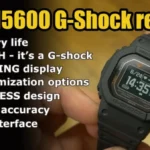
- Compared: smartwatch ecosystem The reviewer said the DW-H5600 is not an Apple Watch or Garmin killer because the app and ecosystem lag.
Casio G-Shock DW-H5600 Review
Bottom Line
Choose the DW-H5600 if you want a durable, stylish G-Shock with basic health data and a great MIP display. Skip it if you need polished apps, broad sport modes, reliable GPS, or full smartwatch tools.
Best for G-Shock fans who want the classic square look, strong durability, basic notifications, and casual health or fitness tracking without wearing a generic touchscreen smartwatch.
Not for serious athletes, app-driven data users, or smartwatch buyers who need built-in GPS, broad sport modes, contactless payments, music controls, or polished third-party integrations.
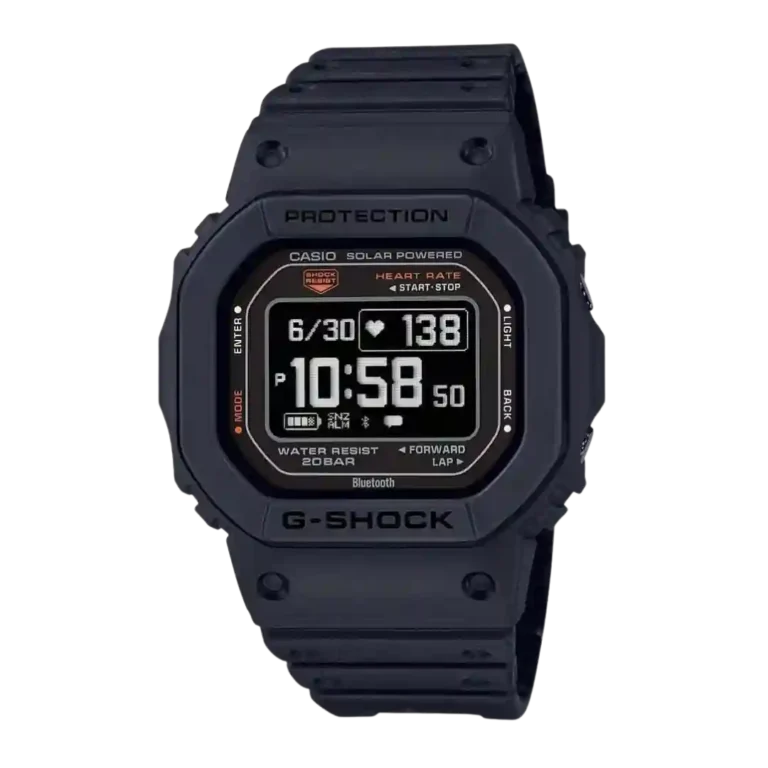
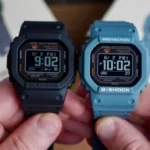
The Casio G-Shock DW-H5600 succeeds most as a classic square G-Shock with modern health extras. Reviewers repeatedly praised the tough build, 200m water resistance, retro styling, soft adjustable band, and crisp MIP display. The tradeoff is that the smartwatch layer feels less mature than the watch hardware: buttons are recessed, the app is clunky, integrations are weak, and workout modes are limited. Fitness data can be good enough for casual runs, walking, steps, sleep, and heart-rate checks, but GPS depends on a phone and accuracy evidence is mixed. It feels most convincing as a durable G-Shock that happens to track health, not as a Garmin or Apple Watch replacement.
Compared in Reviews
Products reviewers directly compared with this model, grouped into quick takeaways.
Garmin Instinct Solar
- Worse: style and everyday preference Despite Garmin’s fitness advantage, the reviewer personally preferred the G-Shock because it looked cooler and met their needs.
- Better: fitness app maturity and data export The reviewer said Garmin is more mature for fitness data, app tools, and external integrations.
Amazfit Band 7
- Compared: distance and heart-rate accuracy The reviewer used an Amazfit Band 7 as a comparison and found the Casio undercounted distance and varied in heart rate.
Feature Scorecards
Pros
-
Water resistance is consistently strong, with reviewers repeatedly citing 200m or WR20BAR protection.
-
Durability is a major strength, with repeated praise for shock resistance, G-Shock toughness, rugged construction, and long-term wear.
-
Outdoor visibility is excellent overall, with multiple reviewers praising sunlight readability and the MIP screen’s high contrast.
-
Style and design earn the strongest consensus, especially the retro square G-Shock look paired with modern health features.
-
Band quality is a strength, with reviewers praising soft, pliable resin and generous adjustment holes.
-
Build quality is mostly strong and authentically G-Shock, with carbon/resin construction, sturdy feel, and some isolated scratch or finish concerns.
-
The MIP display is the standout feature, praised across reviews for crispness, contrast, and legibility despite small data fields.
-
Fit is helped by light weight and many strap holes, though thicker dimensions and small-wrist concerns appear in some reviews.
-
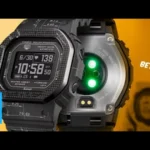
Comfort is mostly positive thanks to lighter, smaller square-G-Shock wearability, but some reviewers felt wrist irritation from the sensor bulge.
-
Battery life is better than many full smartwatches but inconsistent by usage, ranging from 2-3 days to about a week or longer with lighter settings.
-
Materials are generally praised for bio-based resin, soft matte feel, and lightness, though some reviewers noted scratches, fingerprints, or wear.
-
Bluetooth generally works for phone syncing and notifications, though the watch depends heavily on the Casio app and occasional sync steps.
-
Brightness and backlighting are generally good, especially indoors and in the dark, though one reviewer found outdoor workout brightness limited.
-
Sleep tracking was generally useful and sometimes close to Whoop or Oura, but reviewers also found it inconsistent, confusing, or limited by presentation.
-
Activity auto-detection and recognition get limited but positive evidence, with reviewers noting workout recognition and motion sensors that support activity classification.
-
Phone compatibility is broad across Apple and Android, but health-platform compatibility is much less consistent.
-
Charging speed is acceptable rather than exceptional, with reports ranging from about an hour to roughly three hours for a full charge.
-
Customization is better than a simple digital watch, with configurable sport screens, mode ordering, and limited face choices, but it remains modest.
-
Blood oxygen is present and often worked as a manual wellness reading, though some reviewers found measurement inconsistent or limited versus fuller health watches.
-
Notifications are useful for calls, texts, emails, and app alerts, but the small screen and button-heavy controls limit richer interaction.
-
Coaching is basic but real, with targets, cardio-load status, and a useful interval timer rather than a fully motivational training platform.
Cons
-
Heart-rate tracking was often close to straps or other wearables, though several reviewers saw high spikes or meaningful variance during activity.
-
Step counting can be close in daily use, but reviewers also saw overcounting or mixed results when arm movement or workouts confused the watch.
-
Health tracking is credible for casual use but not uniformly trusted, with solid comments from some reviewers and accuracy doubts against competitors from others.
-
Recovery features such as Nightly Recharge and Cardio Load add useful Polar-style context, but several reviewers found the advice opaque or only partly helpful.
-
Menu navigation divides reviewers, ranging from intuitive after learning it to slow, button-heavy, and awkward for frequent use.
-
Fitness tracking works best for casual walking, running, and gym use; accuracy and depth fall short for serious training or competitor-level analysis.
-
Wellness insights are present through breathing, Life Log, Nightly Recharge, and Polar-style data, but the watch often leaves users to interpret raw numbers.
-
Charging convenience is mixed: solar assist helps, but several reviewers disliked the proprietary clip cable or found charging temperamental.
-
Watch faces are sharp on the MIP screen but limited, with reviewers repeatedly noting only three main face options.
-
Software smoothness is uneven: one reviewer liked responsive transitions, while others reported lag, polish issues, or a slow app.
-
Value depends heavily on buyer priorities: G-Shock fans may justify the price, while fitness-focused reviewers compare it unfavorably with Garmin, Fitbit, or Apple options.
-
Smartwatch features are intentionally basic, covering notifications, time tools, phone finder, and health widgets rather than a full Apple Watch-style experience.
-
Workout variety is narrow, usually three or four modes, covering basics like running, walking, gym, and intervals rather than a broad sport library.
-
Pairing and syncing are mixed: some reviewers saw extra taps, long updates, or frustrating setup, while others found it workable after setup.
-
Reliability is mixed, with bugs, update issues, and sensor/software complaints offset by G-Shock hardware confidence.
-
Call handling is limited to alerts or notifications, with reviewers making clear that replies and active handling are not available from the watch.
-
Dedicated stress tracking is weak: one reviewer said it is absent, while another framed the breathing tool as light stress-relief support.
-
The proprietary operating system fits the watch-like identity but is limited and constrained by the small screen and physical controls.
-
The companion app is functional but commonly criticized as clunky, slow, ad-heavy, hard to navigate, or behind Garmin and Apple ecosystems.
-
GPS is the biggest activity-tracking compromise: there is no built-in GPS, and phone-connected accuracy ranged from surprisingly good to unreliable.
-
Calorie tracking is useful as a general activity estimate, but reviewers warned it becomes less trustworthy when heart-rate or sensor readings drift.
-
The user interface keeps a classic G-Shock feel but is widely described as old-school, unintuitive, or hard to use for smartwatch tasks.
-
Third-party support is inconsistent: some reviewers mention Strava or Apple Health paths, while many criticize missing Google Fit, Apple Health, Strava, or export options.
-
Button controls are the most repeated hardware complaint, with recessed, stiff, or hard-to-press buttons making smartwatch use awkward.
-
The app ecosystem is one of the weakest areas, with repeated complaints about poor integrations, locked-in data, and an app experience that trails Garmin or Apple.
-
Music control support is weak to absent, with reviewers noting no music features or no pause/play control.
-
There is no touchscreen, which reinforces the classic G-Shock appeal but makes interaction depend on physical buttons.
-
Contactless payments are not supported in the reviewed feature set.
-
Wi-Fi is absent, so connectivity depends on Bluetooth and the paired phone.
Compared With Category Average
Compared with other Smart Watch, this product is below average in touchscreen responsiveness, music controls, button controls.
| Attribute | This product | Category average | Difference |
|---|---|---|---|
| touchscreen responsiveness | 1.0 | 3.7 | -2.7 |
| music controls | 1.0 | 3.5 | -2.5 |
| button controls | 1.9 | 3.9 | -2.1 |
| Wi-Fi connectivity | 1.0 | 3.2 | -2.2 |
| app ecosystem | 1.7 | 3.6 | -1.9 |
| workout tracking variety | 2.7 | 4.4 | -1.8 |
| contactless payments | 1.0 | 2.9 | -1.9 |
| GPS accuracy | 2.4 | 4.0 | -1.6 |
FAQ
Is the Casio G-Shock DW-H5600 a full smartwatch?
No. Reviewers describe it as more of a G-Shock with health, fitness, Bluetooth, and notification features than a full Apple Watch-style smartwatch.
How good is the DW-H5600 display?
The MIP display is one of the most praised parts of the watch. Reviewers liked its crisp contrast, readability, and outdoor visibility, though some found the screen small for dense data.
Does the DW-H5600 have built-in GPS?
No. It relies on connected GPS from a phone, and reviewer accuracy results ranged from good enough to unreliable.
Are the fitness features accurate?
They are acceptable for casual use, especially heart rate in several tests, but reviewers reported mixed results for distance, calories, steps, and some recovery guidance.
How long does the battery last?
Most reviewers saw about a week with typical use, but heavy heart-rate, notification, sleep, and workout tracking could shorten it. Solar assist helps but does not remove the need for the clip charger.
What are the biggest drawbacks?
The most common drawbacks are stiff recessed buttons, a clunky app, weak third-party integration, limited sport modes, no touchscreen, no payments, and no music controls.
Who will like the DW-H5600 most?
It fits people who already like G-Shock styling and want basic health data, notifications, and a tougher watch-like design more than a mature fitness ecosystem.
Consider This Instead
If you want better touchscreen responsiveness
Choose Apple Watch Ultra 2. It scores 4.9 vs 1.0 for touchscreen responsiveness, with a 4.3 overall score.
If you want better contactless payments
Choose Apple Watch SE 3. It scores 4.8 vs 1.0 for contactless payments, with a 4.1 overall score.
If you want better app ecosystem
Choose Apple Watch Ultra 3. It scores 4.9 vs 1.7 for app ecosystem, with a 4.2 overall score.
If you want better button controls
Choose Garmin Forerunner 970. It scores 4.8 vs 1.9 for button controls, with a 4.0 overall score.
Overall Top Smart Watch Alternatives
Good if you want the most rugged Apple Watch, brighter outdoor screen, better battery, LTE, and top apps. Skip it if you need Garmin-like mapping, recovery analytics, smaller sizing, or...
Pros: display quality, heart rate accuracy
Cons: cross-platform compatibility, recovery insights
Choose the Galaxy Watch 6 for a polished Android smartwatch with a bright screen, strong apps, and broad health tracking. Skip it if battery life, iPhone support, or full non-Samsung...
Pros: outdoor visibility, workout tracking variety
Cons: cross-platform compatibility, battery life
Good if you need a rugged Garmin with deep outdoor, tactical, GPS, training, and battery features. Skip it if you want a cheaper lifestyle watch or do not need the...
Pros: materials quality, durability
Cons: LTE connectivity, value for money
Good if you want premium golf maps, virtual caddie tools, health metrics, music, notifications, and long battery life in one watch. Skip it if you only need basic yardages or...
Pros: pairing reliability, brightness
Cons: software smoothness, user interface