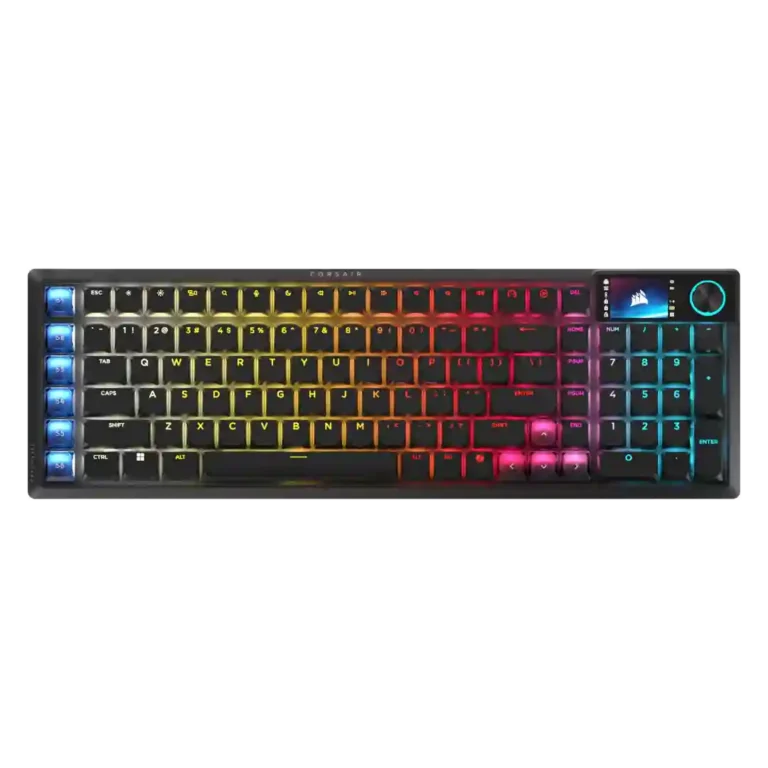
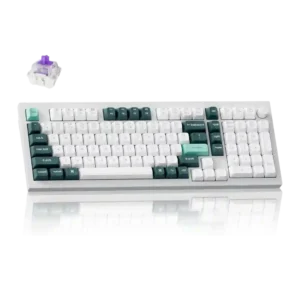
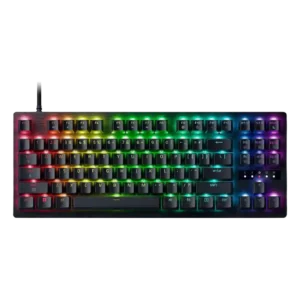
Choose it for exceptional low-profile typing, fast wireless gaming, and Stream Deck shortcuts in a compact numpad layout. Skip it if you want Hall Effect tuning, long battery life, mature software, or strong value.
Best for
Best for gamers, creators, and productivity users who want excellent low-profile typing, a numpad, fast tri-mode wireless, and programmable Stream Deck shortcuts in one premium board.
Not for
Not ideal for value-focused buyers, all-day wireless users with bright RGB, traditional-layout typists, or competitive players who require hot-swap switches, analog input, adjustable actuation, and rapid trigger.
Verdict
Across the full review set, the Vanguard Air 99 earns near-universal praise for its smooth OPX switches, refined acoustics, rigid premium construction, and wired-like Slipstream performance. The 99% layout is genuinely useful for buyers who need a numpad without a conventional full-size footprint, while Stream Deck keys and the rotary dial can meaningfully streamline creator workflows. However, this is not a future-proof competitive board: it lacks hot-swap, analog input, adjustable actuation, and rapid trigger. The compressed layout causes frequent mis-presses for some users, and the LCD often adds less utility than its battery cost suggests. Web Hub is convenient but unevenly mature, with occasional Stream Deck and wake reliability issues. At roughly $260, it is compelling only when its exact blend of feel, wireless speed, numpad, and workflow controls matches your needs.
The pre-lubed OPX low-profile switches are the product’s clearest success: smooth, light, cushioned, and satisfying with enough travel to avoid a laptop-keyboard feel.
Slipstream wireless is a major strength, delivering stable, responsive, high-polling operation with virtually no perceived compromise versus wired mode.
Wired and Slipstream wireless latency is effectively imperceptible. Reviewers reported no lag in competitive play, with sub-millisecond behavior and reliable rapid inputs.
Construction is a standout strength, with a rigid aluminum-accented frame, tight assembly, and premium finish. Reviewers found little to no flex, creaking, or cheapness.
Short 1.5mm actuation and light force make keypresses exceptionally quick without feeling uncontrollably sensitive. Responsiveness remains strong in both games and everyday typing.
The board has an unusually refined low-profile sound: muted, deep, and smooth rather than hollow or plasticky. Its restrained thock suits both gaming setups and shared workspaces.
Tri-mode connectivity is excellent, offering fast Slipstream 2.4GHz, Bluetooth, and detachable USB-C wired use. Switching modes is easy and the wireless link generally behaves like a wired connection.
Five internal dampening layers and gasket mounting soften bottom-out, reduce vibration, and give the board a polished sound uncommon among thin keyboards.
The slim aluminum-edged body looks clean, modern, and premium without excessive gaming styling. Black and white versions fit equally well on a work desk or gaming setup.
Fast optical switches, N-key rollover, FlashTap, and low-latency wireless produce excellent gaming performance. Inputs feel immediate, and several reviewers noticed cleaner movement in competitive titles.
Typing is consistently described as smooth, refined, and among the best available on a low-profile board. Gasket mounting and dampening add substance without sacrificing speed.
The keyboard is impressively quiet for a gaming board, making late-night use and shared offices practical. Its sound stays muted and controlled rather than clicky or obnoxious.
OPX optical switches register evenly and reliably, with reviewers repeatedly describing their response as immediate and consistent across typing and gaming.
Windows and macOS support is strong, and the keyboard also works with PlayStation and Xbox under the appropriate connection mode. Included Mac keycaps and a hardware OS switch make platform changes straightforward.
RGB illumination is bright, even, and attractive, with sharp legend transmission and limited bleed. The translucent arrow and SD caps create a stronger glow that may not suit every taste.
The rigid frame, double-shot keycaps, firm feet, and contactless optical switches inspire strong long-term confidence. Regional ABS keycaps are the main materials caveat.
PBT double-shot caps on supported regional versions feel solid, resist shine, and show little oil or fingerprint buildup. Some regions receive ABS instead, and the mixed translucent styling is subjective.
Up to five profiles and hardware storage support switching between gaming, work, and other systems. Browser-based management is convenient when local software cannot be installed.
The 99% layout keeps a numpad and function row while using less horizontal space than a conventional full-size board. It frees meaningful mouse room without abandoning productivity keys.
Onboard storage preserves key assignments, lighting, and at least one hardware profile, making configured settings portable across computers and consoles.
The slim 99% chassis is an effective middle ground for users who need a numpad but want less bulk. It is narrower than full size, though still larger than TKL and 75% alternatives.
Web Hub exposes broad control over remapping, macros, lighting, profiles, polling, FlashTap, the dial, and display. Some reviewers still found advanced lighting, screen, or dial options more limited than the hardware suggests.
Most reviewers found the low height, light force, and cushioned bottom-out comfortable for long sessions. Comfort can fall sharply for users who never adapt to the compressed layout.
Most reviewers consider it an excellent premium low-profile keyboard, especially for mixed gaming and productivity. Enthusiasm drops when price, battery life, software roughness, or the compressed layout matter more than its feel.
The rotary dial is useful for volume and other incremental actions, while secondary media functions remain accessible. The lack of a full dedicated media-key bank may disappoint some users.
The six SD keys can launch apps, run macros, control media, and access Stream Deck plugins. They are powerful for creators, though separate software, static legends, and occasional persistence issues reduce polish.
8,000Hz works over wired and 2.4GHz connections and supports very low latency. Several reviewers called the practical gain over 1,000Hz small while noting added battery and system cost.
The low height and adjustable feet can reduce wrist strain, but the compressed clusters and left-side SD keys divide users. Some adapted quickly; others remained uncomfortable or misaligned after days of use.
Web Hub is clean and avoids heavy background software, but launch-period support remains uneven. Slow loading, split Stream Deck management, firmware friction, and missing controls keep the software behind the hardware.
Lighting effects, layers, brightness, and Game Mode colors offer useful personalization, but effect creation and truly granular per-key control are more restricted than expected at this price.
FlashTap, Game Mode, the LCD, and Stream Deck controls add real capability, but their usefulness varies sharply. FlashTap is widely liked, while the screen is often criticized as limited or battery-hungry.
Battery life is the main hardware compromise. Moderate settings can stretch toward the quoted 55 hours, but bright RGB and the LCD commonly reduce real use to roughly 20–30 hours.
The compressed 99% arrangement is the most repeated usability complaint. Close clusters and the extra left column can cause wrong-key presses, mistyped words, and a meaningful learning curve.
Core wireless input is usually stable, but some testers encountered wake failures or Stream Deck recognition and persistence problems. Firmware maturity may determine whether these edge cases improve.
At roughly $260, value is highly conditional. The price makes sense only for buyers who will use the low-profile feel, wireless 8K, numpad, LCD, and Stream Deck controls together.
Although every key is illuminated, the current controls lack truly granular per-key combinations of color and effect, limiting advanced custom lighting designs.
Only fixed OPX optical switches are offered, with no Hall Effect, alternate feel, or adjustable-actuation option for buyers who want deeper switch choice.
Rapid trigger is absent, leaving the keyboard behind modern Hall Effect competitors for reset-point tuning and advanced competitive input control.
Compared With Category Average
Compared with other Gaming Keyboards, this product is above average in portability, legend visibility, stabilizer quality, near average in software quality, design aesthetics, below average in rapid trigger support, ease of switch replacement, hot-swappable switches.
Summary
52 compared features
Above average0.4+ pts higher
25(48%)
Same as averagewithin 0.3 pts
13(25%)
Below average0.4+ pts lower
14(27%)
Largest category differences
Attribute
This product
Category average
Difference
rapid trigger support
1.3
3.6
-2.3
ease of switch replacement
1.5
3.8
-2.3
hot-swappable switches
1.3
3.5
-2.1
per-key lighting control
2.0
4.1
-2.1
analog input support
1.3
3.2
-2.0
wrist rest quality
1.5
3.3
-1.8
value for money
2.5
3.7
-1.2
key spacing
2.6
4.0
-1.3
Consider This Instead
If you want better per-key lighting control
Choose Logitech G915 X Lightspeed. It scores 4.6 vs 2.0 for per-key lighting control, with a 4.0 overall score.
Similar: overpricingThe reviewer considers the Air 99 similarly overpriced to the K100 Air.
Alternative: full-size low-profile layout and battery lifeThe older K100 Air remains an alternative for stronger battery stamina and traditional macro keys, but lacks newer controls and 8K wireless.
Better: Stream Deck functionality and priceThe Galleon offers a full Stream Deck and deeper FPS features for nearly the same price, weakening the Air 99’s value.
Better: layout navigation and comfortThe reviewer finds Logitech’s board easier to navigate among low-profile options.
FAQ
Is the Corsair Vanguard Air 99 good for competitive gaming?
Yes. Its responsive OPX switches, very low latency, 8K wired and wireless polling, N-key rollover, and FlashTap perform extremely well, though it lacks adjustable actuation and rapid trigger.
How does it feel for typing?
The switch feel, gasket mount, and sound dampening are widely praised as smooth, quiet, and unusually refined for a low-profile keyboard. The compressed key spacing and left-side SD keys can require a substantial adjustment period.
How long does the battery last?
Corsair quotes up to roughly 55 hours under restrained settings. With the RGB and LCD active, reviewers commonly reported or expected about 20–30 hours.
Does it support hot-swap, analog input, or rapid trigger?
No. The fixed OPX optical switches are not hot-swappable and do not offer analog input, adjustable actuation, or rapid trigger.
Does it work with Mac and consoles?
Yes. It supports Windows and macOS with included Mac keycaps and an OS switch, and reviewers also confirmed PlayStation and Xbox compatibility through supported connection modes.
Is it worth the $260 price?
Only for buyers who will use its exact combination of premium low-profile feel, numpad, fast wireless, LCD, dial, and Stream Deck controls. Reviewers generally considered it overpriced for simpler gaming or productivity needs.
Sample Expert Reviews We Analyzed
These are a few of the reviews included in our analysis.
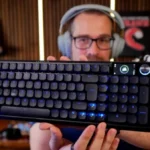
Good if you want a premium 96% Hall Effect keyboard for work and gaming with excellent build, sound, and customization. Skip it if you need cheaper esports-first speed, 8,000Hz polling,...
Good if you want a premium full-size Hall Effect keyboard with smooth switches, quiet sound, and deep customization. Skip it if you need a portable, budget-friendly board or broad switch...
Choose the P65 for premium aluminum construction, excellent thocky typing, flexible wireless modes and deep VIA customization at a strong price. Skip it for travel, adjustable ergonomics, silent offices or...
Best for a compact, tank-like 75% board with excellent typing, marathon battery life, and deep customization. Skip it if you need portability, adjustable feet, magnetic-switch features, or cannot risk the...
Pros: legend visibility, RGB customization
Cons: actuation consistency, rapid trigger support