
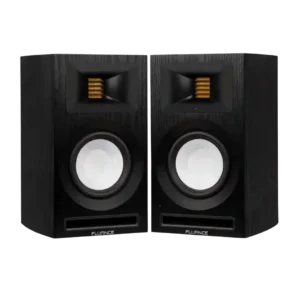
Review: Fluance Ri71 Reference Powered Bookshelf Speakers
Updated: 15 hours ago
3.5
Based on methodology below
268
Insights analyzed
44
Grouped by key features
18
From expert reviews
Scores below reflect consolidated expert coverage across these features.
Bottom Line
Choose the Ri71 if you want real stereo sound, HDMI ARC, and standout value. Skip them if you need Wi-Fi-era conveniences or deep bass without adding a sub.
Best for
Listeners who want a simple 2.0 or 2.1 upgrade for music and TV, especially anyone tempted by a soundbar but willing to place two real speakers. It suits small to medium rooms best and rewards buyers who care more about imaging and tonal balance than app features.
Not for
Buyers who need Wi-Fi streaming, USB or optical inputs, or built-in voice-assistant features should look elsewhere. It is also not the best fit for large rooms or bass-heavy listening unless you plan to add a subwoofer.
Verdict
Fluance's Ri71 gets the hard parts right: convincing stereo imaging, strong detail, enough output for normal living-room use, and unusually good TV integration for powered bookshelf speakers thanks to HDMI ARC and a well-executed subwoofer output. The AMT tweeter gives the sound a crisp, spacious character, while the overall tuning stays balanced enough for both music and movies. The tradeoff is feature depth. You do not get Wi-Fi streaming, an app, optical input, or voice-assistant extras, and the speakers can sound a bit strained in the bass or slightly sharp when pushed hard without adding a sub. Within those limits, they are one of the better $400 soundbar alternatives.
Pros
-
4.7based on 5 reviewsSetup simplicity: 4.7, based on 5 reviewsEase of setup is one of the Ri71's strongest usability wins, especially for people moving up from TV speakers or a soundbar.
-
4.7based on 2 reviewsCohesive presentation: 4.7, based on 2 reviewsEven when the speakers sound large and expansive, reviewers often describe the presentation as integrated and coherent rather than smeared or disjointed.
-
4.6based on 10 reviewsStereo imaging accuracy: 4.6, based on 10 reviewsStereo imaging is excellent for the money, with stable center focus, wide separation, and convincing placement of voices and instruments.
-
4.6based on 10 reviewsValue for money: 4.6, based on 10 reviewsValue is one of the strongest themes across the reviews, with many writers saying the Ri71 outperforms typical soundbars and many similarly priced powered speakers.
-
4.6based on 12 reviewsDetail retrieval: 4.6, based on 12 reviewsDetail retrieval is one of the Ri71's clearest strengths, especially in the treble, ambience, and subtle instrumental textures.
-
4.5based on 9 reviewsSubwoofer: 4.5, based on 9 reviewsThe subwoofer output is a real strength, and the automatic 80Hz high-pass behavior makes 2.1 expansion especially effective.
-
4.5based on 1 reviewAudio format support: 4.5, based on 1 reviewCodec and signal support are solid for the price, with AAC and aptX-family Bluetooth plus HDMI ARC, though the omission of USB and optical narrows digital-audio flexibility.
-
4.5based on 8 reviewsSetup simplicity: 4.5, based on 8 reviewsBasic setup is straightforward: connect the speaker wire, power the active cabinet, choose a source, and go.
-
4.5based on 6 reviewsCabinet construction / bracing: 4.5, based on 6 reviewsThe MDF cabinets, internal bracing, curved sides, and front slot port are consistently described as solidly built for the class.
-
4.4based on 9 reviewsLoudness / maximum volume: 4.4, based on 9 reviewsOutput is strong for a compact powered pair, with enough headroom for living rooms and small home-theater use.
-
4.4based on 6 reviewsDialogue clarity (for TV/soundbar use): 4.4, based on 6 reviewsFor TV use, dialogue stays centered and intelligible, making the Ri71 a credible soundbar alternative.
-
4.4based on 4 reviewsAesthetic design / Finish options: 4.4, based on 4 reviewsAcross reviews, the Ri71's walnut, white, and black finishes are a real plus, with walnut especially well liked, though the exposed drivers and lack of grilles make the styling more assertive than discreet.
-
4.3based on 11 reviewsHome theater integration: 4.3, based on 11 reviewsThe Ri71 integrates unusually well into TV setups thanks to ARC, stereo width, and easy subwoofer expansion.
-
4.3based on 10 reviewsBluetooth codec support: 4.3, based on 10 reviewsBluetooth support is better than average here, with aptX HD commonly highlighted and some reviews also noting AAC, SBC, and aptX Low Latency.
-
4.3based on 6 reviewsDynamic headroom: 4.3, based on 6 reviewsDynamic expression is strong for the size, especially once bass duties are shared with a subwoofer.
-
4.3based on 4 reviewsBluetooth connection stability: 4.3, based on 4 reviewsBluetooth pairing is generally described as fast, easy, and stable for everyday playback.
-
4.3based on 3 reviewsVoice clarity: 4.3, based on 3 reviewsVocals are consistently reproduced with clarity, body, and stable placement, whether for music or spoken content.
-
4.3based on 6 reviewsWired input quality: 4.3, based on 6 reviewsAnalog RCA and HDMI inputs sound good, and some reviewers preferred wired sources over Bluetooth for the best bass weight and overall refinement.
-
4.2based on 12 reviewsFrequency response balance: 4.2, based on 12 reviewsConsensus points to a balanced, near-neutral tuning with good bass weight for the size, though some listeners hear a slightly forward upper range or limited deepest bass.
-
4.2based on 1 reviewControl button responsiveness: 4.2, based on 1 reviewThe remote buttons and main controls usually register cleanly, though a few reviewers found the endlessly rotating tone and volume controls less intuitive than ideal.
-
4.2based on 8 reviewsPrice: 4.2, based on 8 reviewsAt roughly $400, the pricing is seen as competitive rather than ultra-cheap, especially given the ARC input and AMT tweeters.
-
4.1based on 7 reviewsSoundstage height: 4.1, based on 7 reviewsSeveral reviewers praise the sense of height and scale the Ri71 can throw when positioned well, especially versus compact soundbars.
-
4.1based on 10 reviewsDesign and aesthetics: 4.1, based on 10 reviewsMost reviewers like the classic bookshelf look and visible drivers, but the no-grille design and slightly old-school finishes will not suit every room.
-
4.1based on 4 reviewsEQ customization: 4.1, based on 4 reviewsBass and treble controls are useful and widely appreciated, even if they are basic rather than app-driven EQ.
-
4.1based on 8 reviewsWeight convenience: 4.1, based on 8 reviewsFor a real bookshelf pair, the cabinets are compact and manageable enough for shelves, consoles, or stands, though they are not tiny desktop speakers.
-
4.0based on 5 reviewsLow-volume performance: 4.0, based on 5 reviewsIn smaller rooms and quieter listening, the Ri71 still preserves detail and tonal balance reasonably well, though bigger spaces may want a sub or a little bass lift.
-
4.0based on 11 reviewsHDMI ARC): 4.0, based on 11 reviewsHDMI ARC is a major selling point and usually works well, but a few reviewers ran into picky or inconsistent behavior with certain displays.
-
3.9based on 13 reviewsRemote control usability: 3.9, based on 13 reviewsThe included remote is genuinely useful, covering source, volume, playback, LED brightness, and tone adjustments, though it is plain and occasionally quirky.
-
3.9based on 11 reviewsDistortion at high volume: 3.9, based on 11 reviewsThe speakers stay composed at sane loud levels, but multiple reviews note some bass strain, honkiness, or treble edge when pushed very hard.
-
3.8based on 10 reviewsOn-device controls: 3.8, based on 10 reviewsThe on-speaker volume knob and rear tone controls are handy, but their placement and endless rotation drew mixed reactions.
-
3.7based on 5 reviewsStatus indicators: 3.7, based on 5 reviewsThe front LED provides useful source and status feedback and can be dimmed or switched off, but brightness and color-coding drew some complaints.
-
3.6based on 2 reviewsInter-speaker connectivity: 3.6, based on 2 reviewsUsing standard speaker wire between the active and passive cabinets is flexible, but the included cable is basic and the one-box electronics create some asymmetry.
-
3.5based on 15 reviewsWired input availability: 3.5, based on 15 reviewsInput selection covers the essentials with HDMI ARC, RCA, Bluetooth, and sub-out, but the lack of optical and USB keeps the set from feeling fully loaded.
Cons
-
2.0based on 1 reviewSurround sound simulation: 2.0, based on 1 reviewThe Ri71 does not offer real surround virtualization; its appeal comes from honest stereo width rather than simulated Atmos effects.
-
2.0based on 4 reviewsSmart features: 2.0, based on 4 reviewsFeature depth is deliberately limited: you get HDMI ARC, Bluetooth, tone controls, and sub-out, but no app, Wi-Fi, voice control, or broader smart ecosystem.
-
1.1based on 6 reviewsoptical: 1.1, based on 6 reviewsReviewers repeatedly call out the missing optical input as one of the biggest connectivity omissions.
-
1.0based on 4 reviewsWi-Fi streaming reliability: 1.0, based on 4 reviewsWi-Fi streaming is absent altogether, so reliability for network playback is effectively a non-feature.
-
1.0based on 3 reviewsApp reliability: 1.0, based on 3 reviewsThere is no Fluance companion app, leaving source and tone changes to the remote and physical controls.
-
1.0based on 1 reviewAirPlay compatibility: 1.0, based on 1 reviewReviews repeatedly note there is no Wi-Fi platform, so AirPlay-style network streaming is effectively absent.
-
1.0based on 1 reviewChromecast compatibility: 1.0, based on 1 reviewBecause the Ri71 lacks Wi-Fi or network audio, Chromecast-style casting is not part of the feature set.
-
1.0based on 1 reviewSmart assistant integration (Alexa: 1.0, based on 1 reviewThere is no built-in Alexa-style assistant layer here; the Ri71 is a straightforward speaker system rather than a smart speaker.
-
1.0based on 1 reviewSpotify Connect reliability: 1.0, based on 1 reviewWithout Wi-Fi networking, Spotify Connect is not available as a native streaming option.
-
1.0based on 1 reviewVoice assistant responsiveness: 1.0, based on 1 reviewBecause there is no onboard voice-assistant platform, there is no meaningful assistant responsiveness to evaluate.
-
1.0based on 1 reviewVoice recognition accuracy: 1.0, based on 1 reviewNo built-in voice-assistant system means there is no voice-recognition feature to speak of.
FAQ
Is the Ri71 a better buy than a budget soundbar?
For music quality, stereo width, and dialogue placement, most reviews prefer it to similarly priced soundbars. A budget soundbar still makes more sense if you need a single-box layout or virtual surround effects.
Do these speakers need a subwoofer?
Not necessarily. The Ri71 has usable bass on its own for casual music and TV, but a subwoofer is the recommended upgrade for larger rooms, deeper movie impact, or bass-heavy music.
What inputs are missing?
The main omissions repeated across reviews are Wi-Fi streaming, optical input, USB audio, and app-based control. You get HDMI ARC, Bluetooth, RCA, and a subwoofer output instead.
Are they easy to set up?
Yes. Most reviewers describe setup as plug-and-play: connect the passive speaker, power the active one, pick HDMI ARC, Bluetooth, or RCA, and start listening.
Reviews we analyzed
Video Reviews




Article Reviews


Trustedreviews

Best Bookshelf Speakers
#1

4.5
Choose the REN if you want a stylish, plug-and-play stereo alternative to a soundbar with excellent inputs and imaging. Skip it if you...
Pros: Wired input availability, HDMI ARC), Home theater integration, Bluetooth connection stability, Cohesive presentation, Dialogue clarity (for TV/soundbar use), Stereo imaging accuracy
Cons: none
#2
4.4
Choose the LSX II for compact wireless speakers with standout imaging and flexible streaming. Skip if you need deep bass or large-room volume...
Pros: Wired input availability, Latency with TV (lip sync), Setup simplicity, Design and aesthetics, Stereo imaging accuracy, Cohesive presentation, Audio format support
Cons: On-device controls, Remote control usability
#3

4.3
Choose LS50 Wireless II for reference-level imaging in a sleek all-in-one streamer/TV setup; Skip if you want deep sub-bass without a sub or...
Pros: AirPlay compatibility, Chromecast compatibility, Latency with TV (lip sync), Amplifier power requirements, Audio format support, Voice clarity, Stereo imaging accuracy
Cons: Smart assistant integration (Alexa, Privacy & data, Remote control usability
#4

4.2
Choose LS50 Meta for pinpoint imaging and clean, refined vocals in a compact standmount; Skip if you want deep bass or party-level dynamics...
Pros: Stereo imaging accuracy, Dialogue clarity (for TV/soundbar use), Design & aesthetics, Detail retrieval, Low-volume performance, Cohesive presentation, Voice clarity
Cons: None