- Similar: GPS accuracy TechRadar was satisfied with GPS accuracy when comparing against Apple’s Ultra 2.
- Better: water sports The Watch Ultra was judged less capable for diving-style water sports than Apple’s Ultra.
- Similar: emergency siren loudness The Ultra’s siren was judged about as loud as Apple’s version.
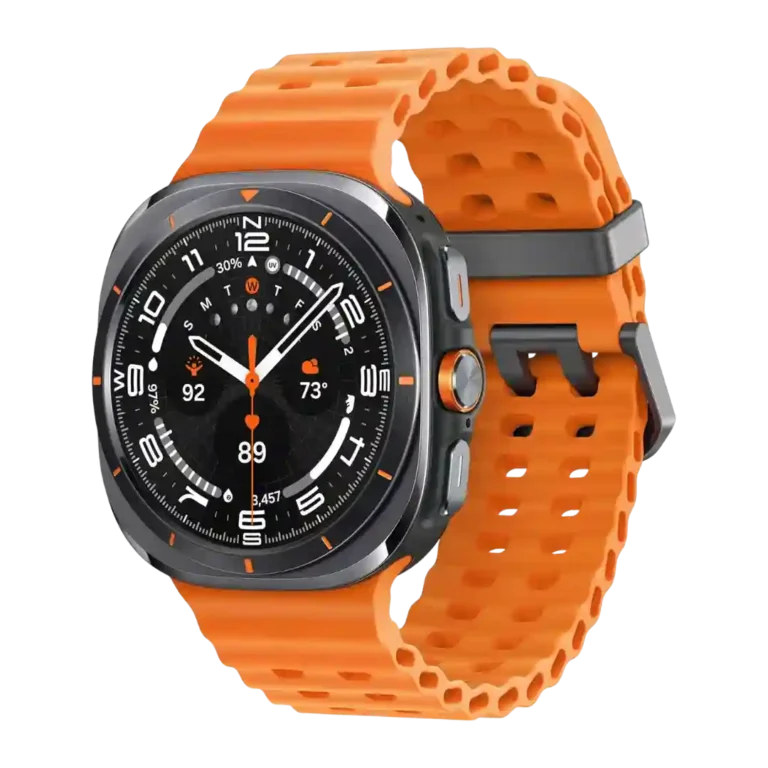
Samsung Galaxy Watch Ultra (2024) Review
Bottom Line
Choose the Galaxy Watch Ultra if you want a rugged Samsung-focused Wear OS watch with strong GPS, a bright display, and multi-day battery. Skip it if you need lower cost, smaller sizing, dive-grade water sports, or elite all-sport accuracy.
Best for Samsung or Android users who want a premium rugged Wear OS watch with a bright display, reliable GPS, useful smart features, and battery life that usually stretches beyond a day.
Not for shoppers who want a small or inexpensive watch, iPhone compatibility, true dive-watch water sports, Garmin-level endurance battery, or consistently elite health and sleep accuracy.
Reviewers consistently frame the Galaxy Watch Ultra as Samsung’s most capable Wear OS watch: rugged, bright, smooth, and far better for battery life and GPS than prior Galaxy watches. The strongest evidence centers on outdoor visibility, durable materials, responsive software, useful quick controls, and mostly accurate GPS, with several reviewers calling it a serious sports-watch alternative. The tradeoff is that the Ultra branding raises expectations it does not always meet. The watch is large, expensive, sometimes awkward to navigate without a physical bezel, and its health metrics are uneven: sleep, stress, blood oxygen, and some heart-rate scenarios drew caveats. It is best understood as a premium Samsung smartwatch with improved fitness credibility, not a full Garmin-style endurance watch or Apple-level dive/sports platform.
Compared in Reviews
Products reviewers directly compared with this model, grouped into quick takeaways.
- Similar: heart rate and GPS accuracy Wareable found its core sports accuracy strong against Garmin’s Epix Pro.
- Similar: GPS accuracy T3 found the Ultra’s GPS accuracy on par with Garmin’s Forerunner 965.
Feature Scorecards
Summary
56 reviewed features- Very positive 4.5-5.0 23% 13 features
- Positive 3.5-4.4 38% 21 features
- Neutral 2.5-3.4 27% 15 features
- Negative 1.5-2.4 13% 7 features
- Very negative below 1.5 0% 0 features
Pros
-
Build quality was a standout strength, with reviewers repeatedly calling it top-notch, excellent, solid, or tank-like.
-
Software smoothness was a strong point, with reviewers repeatedly describing the interface as snappy, glitch-free, or without lag.
-
Display quality was one of the strongest areas, with reviewers calling the AMOLED screen excellent, gorgeous, and among the best on Android watches.
-
Notifications were generally useful and prompt in the scored evidence, helping the watch function as a less distracting phone extension.
-
Outdoor visibility was consistently strong thanks to the bright display, with reviewers reporting easy readability in sun and outdoor workouts.
-
Brightness was widely praised, especially the 3,000-nit display and strong automatic brightness behavior in direct sun.
-
Watch faces were a highlight for several reviewers, with praise for aesthetics, data density, and wide selection.
-
The user interface was praised by the reviewers who scored it, especially for refinement, tiles, and intuitive operation.
-
Call handling had limited but positive evidence, with one long-term reviewer saying calls worked well enough to use more often.
-
Customization was praised for giving easy access to preferred health information and allowing users to tailor the home screen.
-
Flashlight evidence was limited but positive, with one reviewer naming the flashlight shortcut as their favorite Quick Button use.
-
Music controls had limited but positive evidence, with one reviewer liking the ability to pause or skip audio from the watch.
-
Voice assistant evidence was limited but positive when using Google Assistant instead of Bixby.
-
GPS accuracy drew strong agreement: multiple reviewers found routes, lock speed, and distance tracking accurate, with only some urban caveats.
-
Reviewers generally praised automatic workout detection, saying it started or paused workouts reliably and often worked without asking for confirmation.
-
Durability was generally strong, supported by scratch resistance and long-term wear, though one reviewer noted everyday case indentations.
-
Materials quality was praised for titanium and sapphire construction, with reviewers describing the casing and glass as premium or durable.
-
Smartwatch features were praised overall, especially for Samsung users, though some reviewers stressed it is still a large, premium sports-style smartwatch.
-
Wear OS app access was treated as a major strength, with reviewers citing useful mainstream apps and thriving third-party support, though not every customization app remained compatible.
-
Workout variety was good for mainstream exercise and multisport use, though one review noted the data-field depth still trails endurance-focused rivals.
-
Heart rate accuracy was good for many runs and workouts, but several reviews found sport-specific misses, especially cycling, rowing, or rough conditions.
-
Battery life was one of the clearest improvements, usually landing around two to three days, though reviewers still noted it falls short of true outdoor-watch endurance.
-
Fit evidence was limited but positive, with one reviewer able to get a snug, usable fit from the supplied band setup.
-
Safety features had limited positive evidence, with the emergency siren described as loud enough to be meaningful.
-
Fitness tracking accuracy was mostly positive but not flawless, with reviewers finding valid or strong data while also flagging average or sport-specific weaknesses.
-
Comfort was highly wrist-dependent: several reviewers found it comfortable despite the size, while others said it disrupted sleep or remained hard to forget.
-
Recovery insights were useful when tied to Energy Score, Wellness Tips, sleep score factors, and physical recovery context, though reviewers did not treat them as perfect.
-
Button feedback was mixed: reviewers liked the Quick Button and tactile controls, but several missed a rotating bezel or crown-like navigation.
-
Payments were useful and reliable in the positive evidence, though one reviewer found PIN friction annoying.
-
Operating system feedback was mostly positive for Wear OS completeness, though the one-year review noted a One UI update skewed some running metrics.
-
Band feedback was split: several reviewers liked the ease, comfort, or redesigned mechanism, while others criticized the Marine or stock band design.
-
Health tracking accuracy was mixed: some readings closely matched controls, but broader health metrics and fitness tracking drew caveats.
-
Sleep tracking accuracy was mixed: some reviewers found sleep timing and stages accurate, while others saw gaps, inflated scores, or difficulty distinguishing waking from stillness.
-
Pairing reliability was mixed: phone/GPS pairing could be easy or reliable, while power-meter pairing was strongly criticized.
Cons
-
Design reactions were highly polarized: some reviewers loved the bold Ultra look, while others called it derivative, bulky, or aesthetically off.
-
Wellness insights were mixed: Energy Score and tips sometimes felt useful or accurate, while AGEs and some readiness-style metrics were vague or inconsistent.
-
Touch interaction was mixed: the touch bezel could be excellent, but wet or sweaty workout use remained a clear limitation.
-
Step counting was acceptable but imperfect, with one reviewer tolerating discrepancies and another noting phantom steps while driving.
-
Third-party app support was useful through Wear OS, but custom watch-face support created a notable limitation for one reviewer.
-
Water resistance was useful for swimming and surf-style testing, but reviewers repeatedly cautioned that it is not a true dive-sports watch.
-
Coaching evidence was limited and mixed, with strength-training voice guidance seen as potentially useful but dependent on the user’s routine.
-
ECG evidence was limited and lukewarm, with one reviewer finding it interesting but not personally necessary.
-
Charging convenience was mixed: one reviewer liked infrequent charging, while others disliked losing reverse wireless charging.
-
Value was one of the most contested areas because reviewers liked the watch but repeatedly compared its $649 price against cheaper Galaxy alternatives.
-
Reliability was mixed: some reviewers saw software or wear-detection quirks, while another only complained about a missing low-battery warning.
-
Compatibility was a recurring concern: reviewers praised Samsung ecosystem integration but criticized Samsung-phone-only features and Android-only restrictions.
-
Only the one-year review gave opinionated evidence on antioxidant tracking, and it was lukewarm because the reviewer had barely used it and noted it was not passive.
-
Companion app feedback was limited but negative because one reviewer disliked needing three separate Samsung apps to access full watch functionality.
-
LTE connectivity evidence was opinionated around the forced LTE/cellular model, which one reviewer disliked because there was no cheaper Bluetooth-only version.
-
Navigation was a weak spot: reviewers liked basic Track Back or GPX-style routing but criticized missing maps and bare-minimum routing.
-
Charging speed was a repeated weakness, with reviewers often reporting around two hours or saying faster charging should be expected at this tier.
-
Size options were a common limitation because the watch only comes in one large 47mm case and several reviewers found it bulky.
-
Menu navigation was one of the weaker usability areas, mainly because reviewers missed the rotating bezel and found Tile scrolling tedious.
-
Blood oxygen evidence was limited and negative, with one review finding the overnight readings unusually low versus other wearables.
-
Bluetooth-related sensor connectivity drew criticism in the FTP/power-meter context, where the connection was described as spotty.
-
Stress tracking was weak in the available evidence, with one review calling it an afterthought and another saying it made them more stressed.
Compared With Category Average
Compared with other Smartwatches, this product is above average in voice assistant quality, call handling, below average in charging speed, stress tracking, Bluetooth connectivity.
Summary
8 compared features- Above average 0.4+ pts higher 25% 2 features
- Same as average within 0.3 pts 0% 0 features
- Below average 0.4+ pts lower 75% 6 features
| Attribute | This product | Category average | Difference |
|---|---|---|---|
| charging speed | 2.3 | 4.1 | -1.9 |
| stress tracking | 1.8 | 3.5 | -1.8 |
| Bluetooth connectivity | 2.0 | 3.8 | -1.8 |
| menu navigation | 2.3 | 3.8 | -1.5 |
| voice assistant quality | 4.5 | 3.0 | +1.5 |
| blood oxygen tracking | 2.0 | 3.4 | -1.4 |
| value for money | 2.7 | 3.8 | -1.2 |
| call handling | 4.5 | 3.2 | +1.3 |
FAQ
How long does the Galaxy Watch Ultra battery last in real use?
Most reviewers reported around two days, with some reaching closer to three days depending on settings and workout use. Several still said it is not long enough for true weekend backcountry use.
Is the GPS accuracy good?
Yes. GPS accuracy was one of the strongest points, with reviewers finding accurate routes, fast locks, and solid distance tracking, though dense city environments could still cause issues.
Is heart rate tracking accurate?
It is generally good for running and many workouts, but not uniformly excellent. Reviewers flagged weaknesses during cycling, rowing, rough surfaces, or specific high-intensity situations.
Do you need a Samsung phone?
A Samsung phone is not required for basic use, but reviewers repeatedly noted that features such as ECG, blood pressure, some AI features, or sleep apnea tools depend on Samsung phone support.
Is it worth paying more than the Galaxy Watch 7?
Reviewers saw the Ultra as worthwhile mainly for people who value the bigger battery, rugged materials, brighter screen, Quick Button, LTE model, and outdoor-focused build. Many said most Android users get better value from the Watch 7.
Can it handle water sports?
It is fine for swimming and held up in surf-style testing, but reviewers warned it is not a true dive watch and is not suitable for high-pressure water sports like scuba diving or jet skiing.
Sample Expert Reviews We Analyzed
These are a few of the reviews included in our analysis.
Video Reviews
- Review score
- 2.5/5
- Review score
- 4.5/5
- Review score
- 4.1/5
Article Reviews
- Review score
- 3.9/5
- Review score
- 3.4/5
- Review score
- 3.3/5
Consider This Instead
If you want better stress tracking
Choose Garmin Forerunner 970. It scores 5.0 vs 1.8 for stress tracking, with a 4.0 overall score.
If you want better blood oxygen tracking
Choose Garmin Lily 2 Active. It scores 5.0 vs 2.0 for blood oxygen tracking, with a 4.1 overall score.
If you want better charging speed
Choose Garmin Forerunner 570. It scores 5.0 vs 2.3 for charging speed, with a 4.0 overall score.
If you want better Bluetooth connectivity
Choose Amazfit Balance 2. It scores 5.0 vs 2.0 for Bluetooth connectivity, with a 3.9 overall score.
Overall Top Smartwatches Alternatives
Best for rugged outdoor training, long battery life, accurate GPS, maps, calls, and a genuinely useful flashlight. Skip it if the high price, tactical extras, proprietary charging cable, or mixed...
Pros: wellness insights, build quality
Cons: LTE connectivity, band quality
Good if you want the best balanced Apple Watch for an older upgrade, stronger battery, comfort, and health tools. Skip it if you own Series 10, need week-long battery, or...
Pros: ECG functionality, app ecosystem
Cons: cross-platform compatibility, recovery insights
Choose it if you want a rugged Garmin hybrid with real hands, a sharp AMOLED display, strong tracking, and a genuinely useful flashlight. Skip it if price, full maps, onboard...
Pros: heart rate accuracy, GPS accuracy
Cons: onboard music storage, mapping and navigation
Best for bright AMOLED visuals, strong battery life, accurate GPS, maps, and standout value. Skip it if you need rich apps, reliable payments, LTE, ECG, or the cleanest companion app.
Pros: step counting accuracy, menu navigation
Cons: voice assistant quality, contactless payments