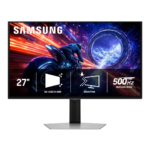
Samsung Odyssey OLED G6 G60SF Feature Scores
Explore all 56 feature scores for Samsung Odyssey OLED G6 G60SF, organized into pros and cons.
Scores by Feature
Summary
56 reviewed features-
Very positive 4.5-5.026 (46%)
-
Positive 3.5-4.418 (32%)
-
Neutral 2.5-3.49 (16%)
-
Negative 1.5-2.43 (5%)
Pros
Sort
-
Competitive gaming is the G6’s clearest strength: 500Hz motion, near-instant pixel response, and very low lag make fast shooters exceptionally clear and responsive. The benefit is greatest when a powerful PC can push very high frame rates.
-
Motion clarity is the standout feature. At very high frame rates, fast objects and text stay exceptionally clear, with multiple testers describing the 500Hz presentation as among the best they have seen.
-
The slim silver chassis, restrained styling, and rear RGB ring give the G6 a polished, modern look. Its design was repeatedly called sleek, classy, and more refined than many gaming-monitor rivals.
-
Picture quality is consistently praised for vibrant color, deep blacks, strong contrast, and crisp gaming presentation. The matte coating and 1440p pixel density introduce tradeoffs, but the overall image remains excellent.
-
Metal construction, refined silver finishes, and a slim chassis give the G6 a consistently premium look and feel.
-
The stand is one of the most consistent strengths, with height, tilt, swivel, and pivot adjustment plus a compact flat base. Movement is generally smooth and stable, though one tester found it somewhat stiff.
-
Input lag is consistently described as effectively imperceptible or extremely low, helping the G6 feel immediate in reaction-heavy games.
-
OLED contrast is effectively infinite in controlled lighting, with excellent shadow separation and no blooming. The matte QD-OLED surface can reduce perceived contrast when strong ambient light raises black levels.
-
Overall sentiment is strongly positive when the G6 is judged as a specialist high-end gaming monitor. The main reservations are price, limited all-round features, and whether a buyer can actually use 500Hz.
-
Pixel response is a unanimous strength, with OLED transitions described as exceptionally fast and effectively free of the sluggishness seen on LCDs.
-
Deep, inky blacks are a major strength in darker rooms and games. Bright ambient light can lift QD-OLED blacks toward gray or purple, especially with the matte coating.
-
HDR is a major strength thanks to per-pixel lighting, deep blacks, wide color, and bright highlights. Peak brightness can approach 1,000 nits in small highlights, though bright-scene dimming and configuration quirks keep it from being universally class-leading.
-
The 500Hz refresh delivers extraordinary smoothness when games can feed it enough frames, and several testers noticed a meaningful jump over 240Hz or 360Hz. Others saw diminishing returns and questioned whether most players need it.
-
The matte coating is highly effective at diffusing direct reflections and is especially useful near bright windows. The tradeoff is slightly reduced punch, occasional grain, and lifted QD-OLED blacks under strong ambient light.
-
Color accuracy is generally excellent, with strong measured results and good factory calibration. One outlet found the SDR defaults too warm and oversaturated, while other tests found only minor tuning was needed.
-
The metal-heavy chassis feels sturdy and flagship-grade, and several testers ranked its construction above competing 500Hz models. A few units showed flex around the rear port area.
-
QD-OLED delivers a very wide gamut with strong DCI-P3 and Adobe RGB coverage, giving games and creative work rich, saturated color. Out-of-box saturation can run hot until sRGB or color management is enabled.
-
Samsung’s passive heat-pipe and graphite-based cooling is repeatedly praised for keeping the OLED panel under control without active fan noise. The thermal system also supports burn-in prevention and longevity.
-
The QD-OLED panel is praised for combining rich color, deep blacks, instant response, and higher brightness than earlier 1440p OLED generations.
-
Brightness is notably stronger than earlier QD-OLED generations, with roughly 300-nit full-screen SDR and high HDR peaks. It still trails the brightest LCD and newer tandem OLED options in some bright scenes.
-
The joystick-driven OSD is generally fast, clear, and easy to navigate, with sensibly organized menus. Placement can be awkward, and some important HDR controls are buried deeper than beginners may expect.
-
The G6 is excellent with a powerful gaming PC, especially in esports titles that can reach several hundred frames per second. Midrange systems can leave much of the 500Hz capability unused.
-
Assembly is consistently simple and tool-free, with stand pieces clipping or twisting securely into place.
-
Viewing angles are excellent, with little visible image degradation from off-center positions.
-
Adaptive sync is usually smooth and tear-free across Nvidia and AMD GPUs, but one test found conspicuous VRR flicker in dark and mid-tone scenes. Samsung’s VRR Control can help, though it may add a little latency.
-
Single-player games still benefit from OLED blacks, color, HDR, and fluid motion, and several testers loved the cinematic image. The small flat 27-inch format and 500Hz price premium make it less compelling if slower cinematic games are the main use.
-
OLED’s self-emissive pixels eliminate the backlight-bleed look seen on LCDs, producing pitch-black edges and dark scenes.
-
Fast-moving objects show essentially no visible trailing or overshoot, one of the clearest advantages of the OLED response behavior.
-
The G6 can handle office and creative work well thanks to strong color and usable 1440p sharpness, but opinions are split for all-day productivity. Text fringing, burn-in risk, missing USB-C, and limited smart/software features make it less ideal as a one-monitor-for-everything setup.
-
Gaming sharpness is generally good at 27-inch 1440p, but text and fine desktop detail lag behind 4K and same-resolution LCDs because of pixel density and QD-OLED’s subpixel layout.
-
1440p is a sensible match for very high frame rates and looks crisp in games at 27 inches, but it is noticeably less dense than 4K. Buyers prioritizing fine text or maximum detail may find the resolution modest for the price.
-
The three-year burn-in warranty is a meaningful safety net and matches the stronger coverage offered by other premium 500Hz OLEDs.
-
The core gaming ports are practical and easy to reach, with HDMI 2.1, DisplayPort, USB-A, and audio covered. Missing USB-C, KVM, and DisplayPort 2.1 keep the selection from feeling fully flagship-grade.
-
Per-pixel OLED dimming gives precise control with minimal blooming and clean separation between bright highlights and dark objects.
-
OLED response remains consistent across refresh rates, so there is no need to retune overdrive as frame rate changes.
-
The tested panel showed very even full-white and dark-gray fields with no dirty-screen effect, reinforcing QD-OLED’s strong uniformity.
-
VRR support covers both AMD FreeSync Premium Pro and Nvidia G-Sync compatibility, giving broad GPU flexibility.
-
The two-port USB hub is useful for peripherals and hard-to-reach PCs, but it is a basic hub rather than a high-end docking solution.
-
Eye-comfort options include glare reduction and settings aimed at reducing fatigue, plus a color-vision accessibility mode. The matte surface is especially helpful when bright reflections would otherwise be distracting.
-
Dynamic cooling and automatic dimming help reduce OLED burn-in risk, but Samsung’s OLED-care controls are less customizable than some rivals.
-
The familiar 16:9 layout was described as an easy, comfortable transition from typical gaming monitors.
-
Standard 100x100 VESA support makes it easy to move the display onto a third-party arm or wall mount when the included stand is not ideal.
-
Samsung provides useful picture controls and flexible sRGB/HDR adjustment, but the preset selection is thinner than some competitors and certain advanced settings are not very explicit.
-
The two full HDMI 2.1 inputs are a welcome part of the connectivity package and can support the monitor’s high-refresh gaming modes.
Cons
Sort
-
Value is the G6’s biggest weakness: multiple outlets found it expensive versus similar 500Hz QD-OLED rivals or cheaper lower-refresh OLEDs. A few lower street prices improved the equation, so discounts matter a lot.
-
There are no built-in speakers, and testers considered that a missed convenience for buyers without room for separate audio.
-
There is no KVM switch, a recurring omission that makes the G6 less convenient for sharing peripherals between multiple computers.
-
The flat 27-inch format cannot match the wraparound immersion of a large curved display, making it less compelling for buyers prioritizing cinematic scale.
-
The large external power brick makes minimalist desk setups harder to keep tidy and complicates cable management.
-
OLED remains vulnerable to permanent retention during long periods of static desktop use, so heavy all-day productivity carries more longevity risk than varied gaming and video use.
-
The 27-inch flat screen cannot deliver the scale or wraparound immersion of an ultrawide, so buyers focused on cinematic field of view have stronger alternatives.
-
Current consoles work with VRR and high-refresh gaming, but they cannot exploit the 500Hz ceiling. For console-first setups, the G6 was repeatedly viewed as overkill.
-
DisplayPort 1.4 with DSC can drive the full 1440p/500Hz experience and was considered functionally adequate. Still, several testers wanted DisplayPort 2.1 at this premium price.
-
Picture-in-picture is absent, but one tester considered that a minor limitation on a 27-inch display where split-screen use is less valuable.
-
Firmware can be updated and Samsung offers some display-management tools, but desktop software control is less complete than several rivals. Buyers who frequently switch color or gaming settings may miss a fuller Windows app.
-
The 27-inch size is ideal for close-up competitive play and smaller desks, but it can feel modest for the price and lacks the cinematic scale of larger displays.