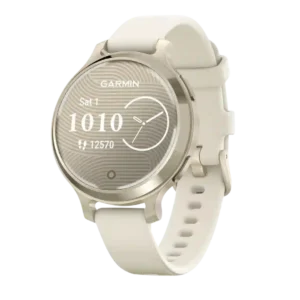
- Alternative: screen and fitness tracking CNET framed the Vivoactive 5 as an Apple Watch SE alternative with a vivid screen and strong fitness tracking.
Garmin Vivoactive 5 Review
Bottom Line
Choose the Garmin Vivoactive 5 for lightweight fitness tracking, strong battery, AMOLED visibility, and wellness insights. Skip it if you need ECG, LTE, calls, maps, premium materials, or advanced training analysis.
Best for Android or iOS users who want a comfortable Garmin with long battery life, accurate core fitness tracking, bright AMOLED visibility, and wellness tools like Body Battery, sleep coaching, stress tracking, and Garmin Coach.
Not for shoppers who want a full smartwatch with LTE, calls, voice assistant support, ECG, maps, or a premium build. Runners who want deeper training load metrics may be better served by a Forerunner.
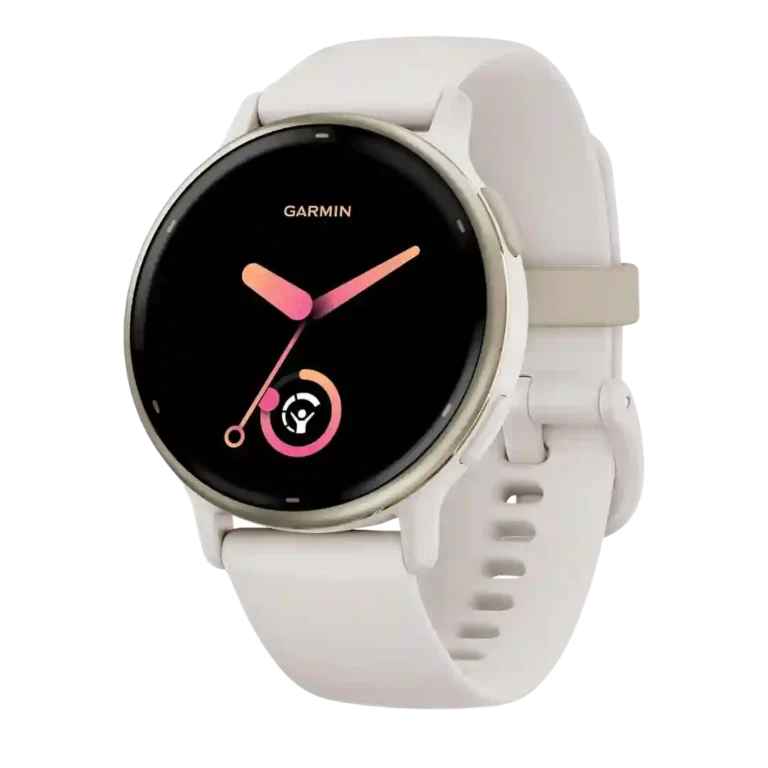
The Garmin Vivoactive 5 comes across as a fitness-first smartwatch with a sharp AMOLED display, comfortable lightweight fit, reliable GPS, generally strong heart-rate tracking, and much better battery life than many full smartwatches. Its best evidence is in everyday health, sleep, stress, steps, workouts, notifications, Garmin Pay, and onboard music. The tradeoff is that Garmin holds back several premium tools: no ECG, LTE, speaker, microphone, voice assistant, barometric altimeter, maps, or deep Forerunner-style training analysis. Reviewers also split on sleep accuracy, interface polish, build feel, and whether the one-size case suits everyone. Overall, it is strongest for active users who value Garmin tracking depth over a richer smartwatch ecosystem.
Compared in Reviews
Products reviewers directly compared with this model, grouped into quick takeaways.
- Worse: battery life The Vivoactive 5 delivered much longer battery life than Apple Watch Ultra 2 in this comparison.
- Alternative: sensors and navigation Reviewers positioned the Forerunner 165 as a better fit for athletes needing more sensors and breadcrumb navigation.
Feature Scorecards
Pros
-
Brightness is a standout thanks to the vibrant AMOLED screen.
-
Outdoor visibility is excellent, with reviewers reporting easy viewing in bright and varied outdoor conditions.
-
Comfort is a major positive; reviewers repeatedly found the watch light and easy to wear all day.
-
Water resistance is strong for the class with a 5ATM rating that supports swimming and showering.
-
Step counting accuracy is a strong point, with reviewer testing showing accurate measured-course results.
-
Fit is comfortable and sensor pressure is low, although the single case size may not fit every preference.
-
Pairing reliability is strong, including a near-seamless iPhone experience and simple Bluetooth setup.
-
Display quality is one of the clearest strengths, with reviewers praising the AMOLED panel in varied conditions.
-
Wellness insights are a core strength, including Body Battery, sleep, stress, breathing, hydration, and meditation features.
-
Fitness tracking accuracy is strong overall, with distance, pace, and heart-rate data generally lining up well.
-
Onboard music storage is a real advantage, with offline Spotify, Deezer, Amazon Music, and local storage support.
-
GPS accuracy is a strength across multiple reviews, including close distance matching and reliable route tracking.
-
Reliability is strong for day-to-day tracking, with consistent data and few obvious false outliers in testing.
-
Stress tracking was generally useful and believable in reviewer daily use, though one transcript refers to it as stretch tracking.
-
Smartphone notifications are good, especially on Android where photos and quick replies are supported.
-
Workout tracking variety is broad, with 30-plus to 50-plus activity options, although some sportier modes and multisport capabilities are missing.
-
Garmin Connect provides detailed data and has improved, though some reviewers disliked needing multiple Garmin apps.
-
Bluetooth pairing and sensor/headphone support are solid, including phone pairing and Bluetooth/ANT+ accessories.
-
Cross-platform compatibility is good because it works with both Android and iOS, though Android gets richer replies.
-
Customization is strong across widgets, activity lists, app lists, shortcuts, and watch presentation.
-
Health tracking accuracy is generally good for core wellness metrics, according to reviewer comparisons and daily use.
-
Style and design are sleek and simple, though more understated than rugged or premium alternatives.
-
Wi-Fi is useful for syncing streaming playlists directly to the watch.
-
Safety features are included through live location sharing and emergency-contact style tools.
-
Music controls are a highlight, especially for workout use.
-
Touchscreen responsiveness is strong in dry use, though wet conditions can make touch control harder.
-
Durability is respectable thanks to Gorilla Glass and water resistance, though the watch is not positioned as rugged.
-
Heart rate accuracy is usually good to excellent, with caveats around optical-sensor lag or spikes during harder efforts.
-
Battery life is a strength overall, but highly setting-dependent: reviewers reported anything from three to four days with heavier always-on/GPS use to about a week or more in lighter use.
-
Garmin Pay is included, making contactless payments available as a useful smartwatch feature.
-
Value for money is favorable for fitness-focused buyers, especially compared with pricier Garmin or smartwatch alternatives.
-
The quick-release band is easy to swap, and reviewers generally found the standard silicone band practical.
-
Coaching features are strong for the class, especially Garmin Coach, free plans, sleep coaching, and workout guidance.
-
Blood oxygen tracking is supported through the pulse oximeter for SpO2-style health and sleep context.
-
Calorie tracking was considered usable, with one reviewer finding calorie numbers generally in the same ballpark as comparison watches.
-
Menu navigation is mostly usable and data-forward, with some learning curve in Garmin’s interface.
-
Smartwatch features cover the basics well, including notifications, payments, weather, music, and health tools.
-
Charging speed is acceptable, with reviewers measuring roughly 98 minutes to about 1.7 hours for a full charge.
-
Watch face quality is decent thanks to always-on support and Connect IQ options, but interactive face behavior can be limited.
-
The Connect IQ ecosystem adds personalization, but reviewers noted extra-app friction and some paid third-party options.
-
Sleep tracking is mixed: some reviewers praised sleep or nap tracking, while others saw missed wakefulness, off stages, or misaligned totals.
-
Third-party app support exists through Connect IQ, Strava, and services, but it is less broad than Apple or Google ecosystems.
Cons
-
The user interface is reasonably streamlined, but reviewers still described Garmin’s organization as imperfect or less intuitive.
-
The two-button setup works, but the watch leans heavily on touch control and is less button-rich than sportier Garmins.
-
Recovery insights are useful and easy to understand, but less advanced than Garmin’s higher-end training tools.
-
The operating system experience is functional but not fully polished in reviewer use.
-
Materials quality is mixed: polymer, aluminum, and silicone keep it light, but some reviewers wanted a more premium feel.
-
Software smoothness is mixed: several reviewers found the interface responsive, while one reported lag, crashes, and stutters.
-
Build quality is functional but mixed, with several reviewers calling out plastic construction, wobbling buttons, or a less premium feel.
-
Auto-detection is present for walks and runs, but reviewer testing found it inconsistent enough to miss some activities.
-
Charging convenience is only fair because the Garmin connector can be knocked loose.
-
Size options are limited because the Vivoactive 5 comes in only one 42mm case size.
-
Call handling is very limited because the watch lacks the speaker and microphone hardware used for Bluetooth calls.
-
Mapping and navigation are weak because reviews note no built-in maps, no on-watch navigation, and no real-time altimeter/elevation guidance.
-
Voice assistant quality scores poorly because voice-assistant support is missing.
-
ECG is not supported because the watch hardware is not capable of it.
-
LTE is absent, so the watch is phone-dependent for connected smartwatch functions.
Compared With Category Average
Compared with other Smart Watch, this product is above average in onboard music storage, contactless payments, below average in mapping and navigation, voice assistant quality, build quality.
| Attribute | This product | Category average | Difference |
|---|---|---|---|
| mapping and navigation | 1.0 | 3.7 | -2.7 |
| voice assistant quality | 0.5 | 2.7 | -2.2 |
| build quality | 2.5 | 4.2 | -1.7 |
| call handling | 1.5 | 3.1 | -1.6 |
| onboard music storage | 4.3 | 2.8 | +1.5 |
| activity auto-detection | 2.4 | 3.8 | -1.4 |
| contactless payments | 4.1 | 2.8 | +1.2 |
| software smoothness | 2.7 | 3.9 | -1.2 |
FAQ
Is the Garmin Vivoactive 5 accurate for workouts?
Yes for most users. Reviewers found GPS, distance, pace, step counting, and heart-rate tracking generally reliable, though optical heart rate can lag or spike during intense intervals.
How long does the battery last?
Reviewers commonly saw around four days with always-on display or heavier GPS use and about a week to eight days with more typical smartwatch use. Garmin's claimed 11 days depends on settings and lighter usage.
Does the Vivoactive 5 have ECG, LTE, or phone calls?
No. Reviews consistently note that it lacks ECG hardware, LTE, a speaker, and a microphone, so it does not handle calls like fuller smartwatches.
Is it good for sleep and wellness tracking?
It is strong for wellness insights such as Body Battery, stress tracking, sleep coaching, HRV, respiration, and blood oxygen. Sleep accuracy was mixed: some reviewers found it accurate, while others saw missed wakefulness or mismatched totals.
Can it store music?
Yes. Reviewers highlighted onboard music storage and support for Spotify, Deezer, and Amazon Music, with Wi-Fi syncing and Bluetooth headphone pairing.
Who should consider a Forerunner or Venu instead?
Consider a Forerunner if you want deeper sports metrics, training load, or more advanced running tools. Consider a Venu model if you want more premium smartwatch hardware such as a speaker, microphone, altimeter, or newer sensor options.
Consider This Instead
If you want better mapping and navigation
Choose Garmin Epix Pro (Gen 2). It scores 4.8 vs 1.0 for mapping and navigation, with a 4.1 overall score.
If you want better call handling
Choose Apple Watch Series 10. It scores 4.6 vs 1.5 for call handling, with a 4.2 overall score.
If you want better size options
Choose Garmin Approach S70. It scores 4.7 vs 2.1 for size options, with a 4.3 overall score.
If you want better build quality
Choose Huawei Watch GT 6 Pro. It scores 5.0 vs 2.5 for build quality, with a 3.9 overall score.
Overall Top Smart Watch Alternatives
Good if you want the most rugged Apple Watch, brighter outdoor screen, better battery, LTE, and top apps. Skip it if you need Garmin-like mapping, recovery analytics, smaller sizing, or...
Pros: display quality, heart rate accuracy
Cons: cross-platform compatibility, recovery insights
Choose the Galaxy Watch 6 for a polished Android smartwatch with a bright screen, strong apps, and broad health tracking. Skip it if battery life, iPhone support, or full non-Samsung...
Pros: outdoor visibility, workout tracking variety
Cons: cross-platform compatibility, battery life
Good if you need a rugged Garmin with deep outdoor, tactical, GPS, training, and battery features. Skip it if you want a cheaper lifestyle watch or do not need the...
Pros: materials quality, durability
Cons: LTE connectivity, value for money
Good if you want premium golf maps, virtual caddie tools, health metrics, music, notifications, and long battery life in one watch. Skip it if you only need basic yardages or...
Pros: pairing reliability, brightness
Cons: software smoothness, user interface