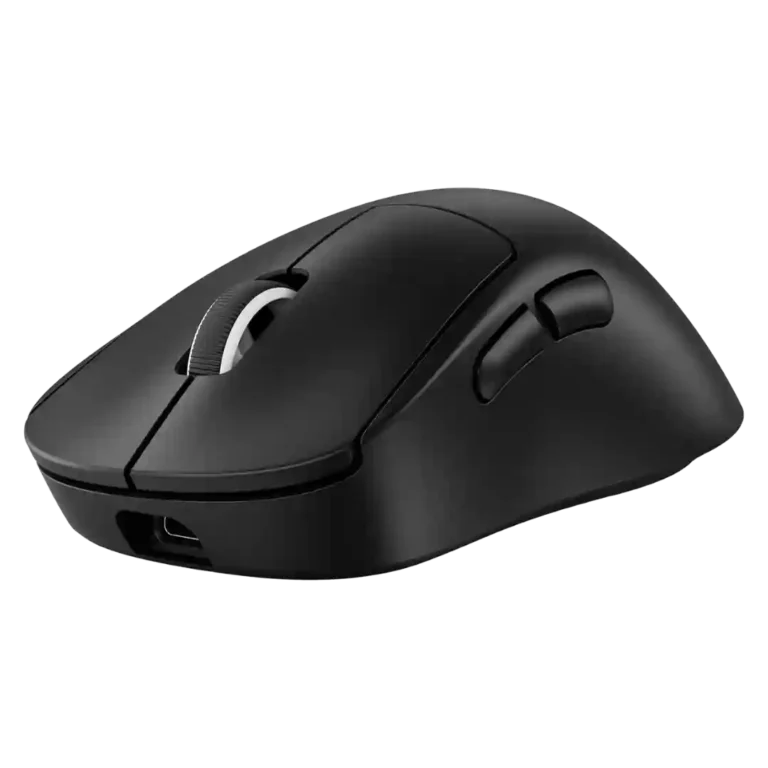
- Similar: body and internals The reviewer framed the DEX as a Superlight 2 with an ergonomic body and similar internal platform.
- Similar: core hardware The reviewer said the DEX is functionally the same as the standard Superlight 2 apart from its shape.
- Similar: performance and shape family The hands-on review described the DEX as a slightly more ergonomic Superlight 2 with similar performance.
Logitech G PRO X Superlight 2 DEX Review
Bottom Line
Choose the DEX if you want a light right-handed FPS mouse with excellent sensor performance, fast wireless polling, and long battery life. Skip it if you need Bluetooth, more buttons, lower price, or a smaller or left-hand shape.
Best for right-handed FPS and competitive players who want a very light ergonomic mouse with top-tier HERO 2 tracking, high wireless polling, long battery life, and strong main clicks.
Not for left-handed users, MMO players, RGB fans, Bluetooth switchers, or buyers who need many buttons, a cheaper price, or a smaller fingertip-focused shape.
The Logitech G PRO X Superlight 2 DEX earns strong reviewer support as a performance-first, right-handed ergonomic mouse. Across reviews, its HERO 2 sensor, high wireless polling, low weight, and long battery life make it feel fast and competitive, especially in FPS play. The tradeoff is that Logitech keeps the shell deliberately simple: no Bluetooth, almost no RGB, no onboard DPI button, and only a five-button layout. Shape response is also not universal. Many reviewers loved the secure palm or relaxed claw feel, while others found the high hump, side curvature, or side-button placement awkward. Its biggest repeat concerns are the price, mushy side buttons, and stock skates that some enthusiasts would replace.
Compared in Reviews
Products reviewers directly compared with this model, grouped into quick takeaways.
- Better: aiming shape The reviewer aimed better with the DeathAdder V3 Pro despite recognizing the DEX as comfortable.
- Better: ergonomics The reviewer found the DeathAdder V3 Pro a stronger ergonomic alternative at the same price.
- Worse: weight The DEX is slightly lighter than the DeathAdder V3 Pro, though the reviewer preferred the DeathAdder for palm grip and smaller hands.
- Alternative: small ergonomic fit The reviewer suggested the DeathAdder V3 Hyperspeed for those who need a smaller ergonomic mouse.
- Better: battery life The reviewer noted a Razer alternative lasts slightly longer, though the DEX still fits well in the market.
Feature Scorecards
Pros
-
Acceleration control is praised where reviewers mention no acceleration, smoothing, or filtering, supporting consistent raw-feeling tracking.
-
Motion consistency is strong, with reviewers reporting clean tracking, no jitter, no dropped tracking, and reliable fast sweeps.
-
Portability is helped by dongle storage and the small receiver, which reviewers appreciated for travel and avoiding lost dongles.
-
Sensor performance is one of the strongest areas, with repeated praise for the HERO 2 sensor, 44K DPI capability, high IPS, and flawless tracking.
-
The DPI range is consistently presented as elite, with the HERO 2 platform described at 32,000 DPI initially and 44,000 DPI after updates.
-
Wireless latency is strong, with reviewers linking LIGHTSPEED, high polling, and optical switches to low-latency responsiveness.
-
Polling rate is a major selling point, repeatedly cited at 8,000Hz wireless after updates, with some reviews noting lower wired limits.
-
FPS gaming suitability is strong, with reviewers specifically testing shooters and praising responsiveness, control, and competitive-grade sensor performance.
-
Wireless performance is strong overall, with reviewers reporting stable, smooth, lag-free operation and confidence moving away from wired mice.
-
Weight is a major strength, with the DEX repeatedly measured around 58 to 60 grams and praised as feather-light for a larger ergonomic mouse.
-
Build quality is broadly positive, with repeated comments about solid construction, no creaks, no flex, and sturdy lightweight materials.
-
Tracking precision is consistently strong, with reviewers calling out pixel-level accuracy, clean fast-motion tracking, and precise in-game aiming.
-
Switch durability is positively supported by reports of reliable optical/mechanical clicks and no double-click issues.
-
Ecosystem integration is strong through G Hub, LIGHTSPEED, onboard profiles, and PowerPlay support, even if the mouse itself stays feature-light.
-
Reviewers describe the DEX as a LIGHTSPEED/2.4GHz dongle mouse, with the high-polling wireless link treated as central to its gaming performance.
-
Connection stability is strong where discussed, with reviewers reporting easy dongle setup and reliable wireless operation.
-
Materials quality is supported by comments about solid lightweight plastic, premium materials, and sturdy construction, though some noted the low weight can initially feel less premium.
-
Left and right click quality is a standout, with reviewers repeatedly praising the Lightforce main clicks as crisp, tactile, snappy, or satisfying.
-
Long-session comfort is a strength for right-handed ergonomic users, with several reviewers mentioning hours of use, long gaming sessions, or extended comfort.
-
Weight balance is mostly praised, with several reviewers saying the mouse feels evenly distributed or well balanced, though one found rear weight concentration awkward.
-
Charging convenience is strong thanks to front USB-C charging, continued use while plugged in, and PowerPlay wireless charging support.
-
Switch feel is a key strength for the main buttons, with reviewers praising Lightforce clicks as crisp, tactile, fast, and satisfying, though not universally premium.
-
Button responsiveness is generally strong, especially for the main clicks, which reviewers describe as tactile, fast, and immediate.
-
Click latency evidence is positive overall, including an extremely low response-time claim and independent wireless latency testing in the low millisecond range.
-
Ergonomic design is one of the product's defining traits, praised by many reviewers as a right-handed shape that improves comfort and control.
-
Battery life is a major strength, usually framed around 90 to 105 hours at normal polling, with some caveats that high polling drains it faster.
-
Palm grip comfort is generally positive for right-handed users and larger hands, though some reviewers with smaller or specific aim grips preferred other shapes.
-
Onboard memory is well supported, with multiple reviews describing onboard profiles or settings saved directly to the device.
-
Shape comfort is the most polarizing core attribute: many reviewers loved the right-handed ergonomic shape, while others found it too large, high, or awkward.
-
Button customization is solid through G Hub remapping, G-Shift, and profile controls, though the small five-button layout limits what can be assigned.
-
Software usability is mixed to positive: G Hub offers useful tuning and remapping, but some reviewers complain about resource use, speed, or interface complexity.
-
Durability over time has limited but positive evidence, mainly from month-long use showing the coating did not decay.
-
Claw grip comfort is mixed but generally usable, with stronger results for relaxed claw and larger hands than aggressive claw on smaller hands.
-
Scroll wheel quality is mixed, ranging from smooth, quiet, and controlled to mushy, loose, or less satisfying than the main clicks.
-
Macro support exists through G Hub, with several reviews mentioning macro creation or shortcut assignment, but the limited button count reduces practical scope.
-
Grip texture is divisive, with some reviewers liking the dry matte coating and others finding it too smooth or slippery without grip tape.
Cons
-
Glide smoothness is mixed: some reviewers praise the PTFE feet and effortless movement, while enthusiast reviewers often recommend replacing the stock skates.
-
Surface compatibility is generally decent, though reviewers note best results on padded or textured surfaces and some glass-pad concerns.
-
Skate durability and skate feel are mixed: reviewers note durable skates, but also thinness, long break-in, or eventual wear concerns.
-
Lift-off distance evidence is conflicting: one review found no adjustment, while others described lift-off settings or calibration options in G Hub.
-
Profile switching is mixed: software profiles and presets are useful, but the lack of a dedicated DPI/profile button frustrated several reviewers.
-
MOBA gaming suitability is adequate but not a headline strength; one reviewer used DOTA2 and found little dramatic difference.
-
Fingertip grip comfort is mixed to weak, with some reviewers saying the larger hump and rear mass make fingertip grip less suitable.
-
Click noise is a tradeoff: main clicks are often crisp and satisfying, but several reviewers note they are loud or high-pitched.
-
Premium feel is mixed: several reviewers praise the build, but at least one said the very low weight first felt less premium or budget-like.
-
Value for money is mixed to weak: reviewers like the performance but repeatedly call out the high price versus cheaper ergonomic or high-end alternatives.
-
Programmable buttons are limited by the five-button layout; remapping exists, but reviewers wanting extra inputs or MMO-style controls will find it sparse.
-
Side button quality is the most repeated hardware complaint, with reviewers citing mushiness, high placement, pre-travel, post-travel, or hard-to-hit buttons.
-
MMO gaming suitability is weak because the mouse has only a simple five-button layout despite some software presets.
-
Cable flexibility is a weakness: reviewers criticize the included cable as rubbery, bad, or not ultralight for wired use while charging.
-
Handedness options are limited because the DEX is designed for right-handed users and is repeatedly described as uncomfortable for left-handed players.
-
Software stability is a weakness where discussed, with one reviewer reporting G Hub freezing, loading problems, crashes, and reinstall trouble.
-
RGB features are minimal to absent, which helps battery life but makes the mouse poor for users who want lighting effects.
-
Bluetooth support is a limitation: reviewers explicitly say the mouse lacks Bluetooth and relies on Logitech's dongle-based wireless connection.
-
Tilt gesture controls are effectively absent; the wheel may move sideways in one review, but the reviewer clarified it is not tilt functionality.
Compared With Category Average
Compared with other Gaming Mouse, this product is below average in Bluetooth support, RGB features, cable flexibility.
| Attribute | This product | Category average | Difference |
|---|---|---|---|
| Bluetooth support | 1.1 | 3.3 | -2.2 |
| RGB features | 1.1 | 3.1 | -2.0 |
| cable flexibility | 1.8 | 3.6 | -1.9 |
| programmable buttons | 2.6 | 4.2 | -1.7 |
| software stability | 1.6 | 3.3 | -1.7 |
| side button quality | 2.4 | 3.8 | -1.4 |
| tilt gesture controls | 1.0 | 2.6 | -1.6 |
| premium feel | 2.7 | 4.1 | -1.4 |
FAQ
Is the Logitech G PRO X Superlight 2 DEX good for FPS games?
Yes. Reviewers repeatedly used it in shooters and praised the HERO 2 sensor, light weight, responsive clicks, and high wireless polling for fast aim and tracking.
Does the DEX work for left-handed users?
Not well. The reviews describe it as a right-handed asymmetrical design, and several specifically warn that left-handed users will be less comfortable.
How long does the battery last?
Most reviews frame battery life around 90 to 105 hours at normal use, with the caveat that very high polling rates and optical-only switch mode can reduce runtime.
Does it support Bluetooth?
No. Reviewers say it relies on Logitech's LIGHTSPEED/2.4GHz receiver, with Bluetooth omitted to prioritize weight and gaming responsiveness.
Are the side buttons good?
They are usable, but they are one of the most repeated complaints. Multiple reviewers describe them as mushy, high, hard to hit, or affected by pre-travel and post-travel.
Is it worth the high price?
The reviews justify the price mainly for serious right-handed FPS players who want Logitech's sensor, wireless performance, and ergonomic shape. Value is weaker for buyers who want more buttons, Bluetooth, RGB, or cheaper ergonomic alternatives.
Consider This Instead
If you want better tilt gesture controls
Choose Logitech G502 X Wired. It scores 4.8 vs 1.0 for tilt gesture controls, with a 4.1 overall score.
If you want better RGB features
Choose Razer Cobra Pro. It scores 4.6 vs 1.1 for RGB features, with a 4.0 overall score.
If you want better Bluetooth support
Choose Razer Cobra HyperSpeed. It scores 4.7 vs 1.1 for Bluetooth support, with a 4.2 overall score.
If you want better handedness options
Choose Logitech G Pro 2 Lightspeed. It scores 4.8 vs 1.6 for handedness options, with a 4.1 overall score.
Overall Top Gaming Mouse Alternatives
Best for a 47g, high-performance 8K wireless mouse with excellent shape, skates, clicks, and web controls. Skip it if stiff side buttons, shorter high-polling battery life, or app/cable quirks would...
Pros: Accuracy and tracking precision, sensor performance
Cons: cable flexibility
Choose it if you want a comfortable, feature-rich wireless mouse for mixed gaming and productivity. Skip it if you need ultralight FPS speed, left-handed support, or better value than discounted...
Pros: programmable buttons, Bluetooth support
Cons: handedness options, firmware reliability
Good if you want an ultra-light esports mouse with 8K wireless, precise tracking, and web setup. Skip it if you need MMO buttons, onboard memory, large-hand palm support, or the...
Pros: polling rate, click latency
Cons: onboard memory, tilt gesture controls
Good if you want ergonomic wireless gaming with hot-swappable batteries and strong tuning. Skip it if price, dock clutter, or short 8K battery life matters most.
Pros: switch durability, DPI range
Cons: grip texture, portability