Corsair Darkstar RGB Review
Bottom Line
Choose the Corsair Darkstar RGB for deep MMO/MOBA controls and strong wireless tracking. Skip it if short battery life, iCUE complexity, or the unusual side-button layout will frustrate you.
Best for MMO, MOBA, ARPG, and productivity users who want many programmable inputs, deep profiles, strong wireless tracking, and a comfortable thumb-grip layout.
Not for buyers who want a traditional 12-button MMO grid, very long RGB-on battery life, simple software, or the lightest possible FPS mouse.
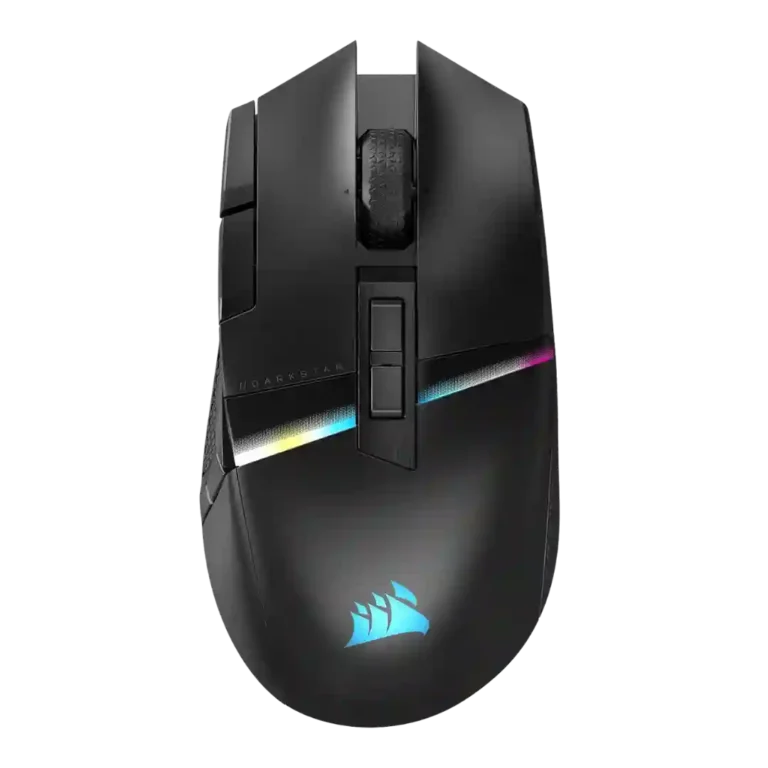
The Corsair Darkstar RGB succeeds as a feature-heavy MMO/MOBA mouse with a strong Marksman sensor, 2.4GHz Slipstream wireless, extensive remapping, and a distinctive tilt-gesture system. Its shape, grip texture, and weight distribution make it more versatile than many button-heavy mice, so several reviews found it usable even in faster shooters. The main tradeoff is that its best ideas require adjustment. The radial side-button cluster is more comfortable than a full keypad for some hands, but less intuitive for others, and iCUE adds power at the cost of complexity and occasional stability concerns. Battery life is also weak with RGB enabled. It makes the most sense for players who will actually use the extra inputs, profiles, and gestures rather than buyers who just want a simple premium wireless mouse.
What Reviewers Agree On
Across the reviews, the Darkstar RGB is treated as a serious MMO/MOBA mouse rather than a normal wireless gaming mouse with a few extra buttons attached. The repeated strengths are its 15 programmable buttons, high-end Marksman 26K sensor, 2.4GHz Slipstream wireless, and deep iCUE customization. Reviewers also gave repeated credit to the premium-feeling shell, textured grip areas, smooth glide, and better-than-expected movement for a mouse in this button-heavy category. Several reviews specifically noted that it can still handle shooters, even though its design priorities are clearly broader than pure FPS speed.
The biggest shared reservation is the control layout. Corsair's six-button radial side cluster gives the thumb a dedicated grip area and reduces accidental clicks for some users, but it also makes certain buttons less immediate than a traditional grid. That creates a learning curve, especially for intense gameplay where fast, automatic access matters. The tilt gesture system is another recurring theme: many reviewers liked the idea and found it genuinely useful or fun, but others noted that it depends on iCUE, needs calibration, or may feel unreliable in fast situations.
Battery life, software, and value are the main practical caveats. Reviews repeatedly describe battery life with RGB as short for a flagship mouse, and several reviewers criticized iCUE for being confusing, awkward, or occasionally unstable. The high price becomes easier to justify only when the buyer needs the full package: MMO/MOBA controls, profiles, macros, tilt gestures, and strong wireless performance. Buyers who want a simpler FPS mouse, a traditional MMO keypad, or long battery life are less likely to be satisfied.
Scored Features
Pros
-
Programmable buttons are the defining feature. Reviewers repeatedly cite 15 programmable buttons or inputs, often tying them to MMO/MOBA play, productivity, and customization.
-
Weight balance is praised when it is discussed. Reviewers who addressed it said the mouse felt well distributed and not excessively heavy despite being heavier than ultralight FPS mice.
-
Click latency is supported mainly through sub-1ms and Quickstrike evidence. Reviewers frame the mouse as low-latency and responsive, especially over Slipstream wireless and with its optical switches.
-
Build quality is strong across the evidence. Reviewers describe solid construction, high-quality hardware, rock-solid assembly, and no rattly or wobbly parts.
-
Premium feel is a repeated positive. Reviewers praise the look, finish, build, customization depth, and high-end feel, although price expectations make missing accessories more noticeable.
-
Surface compatibility is strong. Reviews mention tracking across surfaces, surface calibration, and smooth glide on different surfaces.
-
Switch durability is strong on paper. Reviews point to Omron optical switches, 100 million click claims, and reliable/durable switch behavior.
-
Wireless latency is a strength. Reviews repeatedly cite sub-1ms Slipstream behavior, low-latency play, and responsive wireless performance.
-
Sensor performance is one of the strongest areas. Reviews repeatedly praise the Marksman 26K sensor, high DPI ceiling, smooth tracking, and broad game performance.
-
Left and right click quality is strong. Reviews praise Omron optical switches, Quickstrike implementation, crisp feel, snappy response, and smooth operation.
-
Tracking precision is a clear strength. Reviewers describe accurate tracking, precise flicks, smooth motion, and strong performance across game types and surfaces.
-
The DPI range is a strength. Reviewers repeatedly cite the 26K/26,000 DPI ceiling and fine adjustment options, including one-DPI steps in several reviews.
-
Glide smoothness is frequently praised. Reviewers cite PTFE feet, smooth surface movement, and particularly easy gliding, though one review notes side-edge friction under tilt.
-
Wireless performance is strong overall. Reviews praise Slipstream wireless, broad gaming performance, and genre versatility, while noting that Bluetooth is not the gaming-first mode.
-
The reviews consistently identify 2.4GHz Slipstream wireless as the primary gaming connection. It is tied to the high polling-rate mode and generally treated as the best-performance wireless option.
-
Switch feel is positive. Reviewers describe crisp, quiet, snappy, buttery, or cushiony clicks with good tactile feel.
-
Motion consistency is a strength overall. Reviewers describe smooth, precise movement, low jitter in most tests, and reliable motion, with only limited issues at the highest sensitivity or software-related DPI drops.
-
Customization is a major selling point. Reviews repeatedly point to remapping, DPI tuning, profiles, lighting, gestures, and button assignments as core reasons to consider the mouse.
-
Polling-rate evidence is strong. Reviews repeatedly mention 2,000Hz/2K polling, though one measured result did not fully reach the nominal maximum in testing.
-
Lift-off behavior is positive where discussed. Reviews mention adjustable lift-off distance, improved lift-off control from the side grip, and it also has an instant liftoff detection.
-
Grip texture is a strength. Reviews repeatedly mention textured sides, rubberized grips, and a thumb-grip area that improves control and lift-off confidence.
-
Sensor specifications and testing repeatedly mention high acceleration handling. Reviewers treat the 50G/50Gs acceleration capability as part of the mouse's strong performance package rather than a weakness.
-
Macro support is strong. Reviews repeatedly mention assigning macros, in-game macros, Photoshop macros, media controls, app launches, and other command mappings.
-
Onboard memory is well supported. Several reviews note five onboard or hardware profiles and the ability to store settings on the mouse.
-
Ergonomic design is generally positive. Reviewers cite a comfortable right-handed shape, textured grip, relaxed contouring, and a layout intended for long sessions, although the side-button layout can require adaptation.
-
Click noise is generally controlled. Reviewers describe the clicks as quiet, not overly noisy, or somewhere between loud and muted while still retaining tactile feel.
-
MOBA suitability is also strong. Reviewers repeatedly position the mouse for MOBA use and slower skill-heavy games, with some finding it more natural for MOBAs than traditional MMO grid layouts.
-
Materials quality is well regarded. Reviewers mention soft-touch matte plastic, rubberized or grippy coatings, high-quality hardware, and a premium-feeling exterior.
-
MMO suitability is central to the product. Reviews consistently frame it as an MMO mouse with many programmable inputs, though the nontraditional side cluster creates a learning curve.
-
Button responsiveness is generally strong. Reviewers praise responsive clicks, instantaneous response, snappy feedback, and minimal pre-travel, though one review notes accidental DPI-button brushing.
-
Tilt gesture controls are a distinctive feature not covered by the provided attribute list. Reviewers generally like the extra inputs and customization, but some note reliability, sensitivity, or software-dependence concerns.
-
Claw grip support is favorable in the limited direct evidence. Reviews that discussed claw use said the shape works well for palm and claw users.
-
Corsair ecosystem integration is useful when mentioned. iCUE manages Corsair gear, profiles can link to games, and some reviews note pairing or syncing within Corsair's wider device ecosystem.
-
Connection stability is mostly positive, with reviewers reporting no play-testing issues or a solid 2.4GHz connection. One software/receiver setup issue is captured under software stability rather than this attribute.
-
Shape comfort is mostly good for the intended hand size and grip. Reviews praise the shape and comfort, but some small-hand users or fingertip users found it less natural.
-
FPS suitability is better than expected for an MMO/MOBA mouse. Reviewers say it can handle shooters thanks to sensor quality, weight distribution, and flickability, but several still note it is not a pure ultralight FPS design.
-
Profile switching is broadly supported. Reviews mention profile buttons, five profiles, on-the-fly switching, and game-linked profiles, with occasional confusion or accidental presses.
-
RGB features are extensive but unevenly valued. Reviews note multiple lighting zones and customization, while several say the lighting is partially hidden, subtle, or harmful to battery life.
-
Debounce or response-style customization is supported through button response optimization and tilt sensitivity calibration. Reviewers mainly discuss adjustment controls rather than traditional debounce terminology.
-
Cross-platform support has limited but direct support. One review states Windows and Mac compatibility, while other reviews show secondary-device use and productivity potential.
-
Bluetooth support is widely confirmed and useful for convenience, travel, productivity, or secondary devices. Reviews also note that 2.4GHz remains preferable for gaming latency.
-
Palm grip comfort is generally good. Reviewers with larger or compatible hands say the shape accommodates palm grip, while smaller-hand palm users may find it tall or unwieldy.
-
Long-session comfort is mostly positive but not universal. Some reviews praise comfort over longer sessions, while others note adaptation time or discomfort for smaller hands.
-
Weight is mixed but generally acceptable. Reviewers acknowledge it is heavier than ultralight FPS mice but often praise its relative lightness for the category, balance, and flickability.
-
Portability is moderate. Evidence includes Bluetooth, dongle storage, receiver slots, and travel-friendly connectivity, but the mouse is not presented as an especially compact travel mouse.
-
Durability over time is suggested but not deeply long-tested. Evidence centers on high click ratings and reviewer comments about longevity, with one reviewer explicitly noting that long-term coating or feet durability remains uncertain.
Cons
-
Side button quality is the most debated design point. Reviewers like the accessible extra controls and thumb grip, but several found the unique radial layout awkward, unintuitive, or hard to use quickly.
-
Scroll wheel quality is mixed. Reviewers like tactile or readable steps, but multiple reviews say the wheel is stiff or hard to press.
-
Software usability is mixed. Some reviewers found iCUE powerful and easy after setup, while others called it confusing, unintuitive, complex, or a slog.
-
Fingertip grip evidence is mixed. One review liked the ability to transition to fingertip grip, while another found fingertip use uncomfortable because of the side-button access demands.
-
Value for money is mixed. Most reviews call the mouse expensive, but some argue the features justify the price for buyers who will use the customization, buttons, and gestures.
-
Charging convenience is mixed. USB-C wired use is available, but reviewers complain about the stiff cable, lack of wireless charging, and missing dongle extender in a premium package.
-
Skate durability is uncertain. Review evidence mostly raises concern about PTFE placement or long-term smoothness rather than proving durability over time.
-
Software stability is mixed to weak. Reviews mention iCUE detection problems, receiver setup issues, random DPI drops, and reliance on software for gestures.
-
Battery life is one of the most repeated drawbacks. Reviews cite roughly 20 to 25 hours with RGB or higher-performance use, with better endurance only when lighting is reduced or Bluetooth is used.
-
Firmware reliability has limited negative evidence. One review discussed a random DPI drop and expected a future firmware fix, so the score is cautious rather than broadly conclusive.
-
The included cable is a consistent weak point. Multiple reviews describe it as stiff, not paracord-style, or not flexible enough for serious wired gaming.
-
Handedness is limited. The mouse is repeatedly described as right-handed or semi-contoured for right-handed gamers, and one review explicitly says left-handed gamers need not apply.
FAQ
Is the Corsair Darkstar RGB worth buying?
It is worth considering if you will use the programmable buttons, profiles, macros, and tilt gestures. It is harder to justify if you only need a simple wireless gaming mouse.
What is the main drawback of the Corsair Darkstar RGB?
The biggest drawbacks are short battery life with RGB enabled, iCUE complexity, and the unusual side-button layout that can take time to learn.
Is the Corsair Darkstar RGB good for MMO and MOBA games?
Yes. Reviews consistently describe it as built for MMO and MOBA play, with 15 programmable buttons and profile support, although the radial side cluster may not feel as immediate as a traditional keypad.
Can the Corsair Darkstar RGB work for FPS games?
It can work well for FPS games because the sensor, wireless latency, and weight balance are strong. It is still not a pure ultralight FPS-first mouse, so competitive FPS-only players may prefer something simpler and lighter.
How is the battery life on the Corsair Darkstar RGB?
Battery life is one of the weaker areas. Reviews commonly cite around 20 to 25 hours with RGB enabled, with longer figures only when lighting is off or Bluetooth is used.
Are the tilt gestures useful?
They can be useful and several reviewers found them clever or fun, especially for extra commands. They may require calibration and can depend on iCUE, so they are not equally reliable for every play style.
Is Corsair iCUE easy to use with this mouse?
iCUE is powerful, but reviews were mixed on usability. Some found it manageable after setup, while others called the software confusing, unintuitive, or occasionally unstable.
Video Reviews
Article Reviews
Best Gaming Mouse Alternatives
Choose the Model D3 for flexible wireless gaming, comfort, and precise control. Skip it if the high price or shorter high-polling battery life matters more.
Pros: Accuracy and tracking precision, switch durability, FPS gaming suitability, charging convenience, sensor performance, click latency, wireless latency
Cons: none
Choose the Harpe II Ace for ultralight FPS control, 8K wireless, and easy web setup. Skip it if you need many buttons or steady long battery life in...
Pros: polling rate, weight, wireless performance, DPI range, switch durability, sensor performance, motion consistency
Cons: onboard memory, MMO gaming suitability, software stability, profile switching
Choose the Razer Basilisk V3 Pro 35K for ergonomic comfort, precise tracking, and feature-rich wireless control. Skip it if you want an ultralight FPS mouse or better value...
Pros: motion consistency, sensor performance, DPI range, build quality, macro support, click latency, acceleration control
Cons: handedness options, value for money, weight, fingertip grip comfort
Choose it for precise tracking, comfortable right-handed shape, and swappable switches. Skip it if you need ultralight weight, left-handed ergonomics, or cleaner software value.
Pros: click latency, durability over time, wireless latency, switch durability, Accuracy and tracking precision, 2.4GHz connectivity, sensor performance
Cons: software stability, handedness options, firmware reliability